You just finished a brutal leg day at the gym. Your quads are screaming. Your calves feel like concrete.
You’ve seen people using massage guns, and you’re curious. Can they really help? And more importantly, are they safe to use at home?
The short answer? Yes, when used correctly.
But there’s a right way and a wrong way to use these powerful recovery tools. Let’s make sure you’re doing it safely and effectively.
What Massage Guns Actually Do
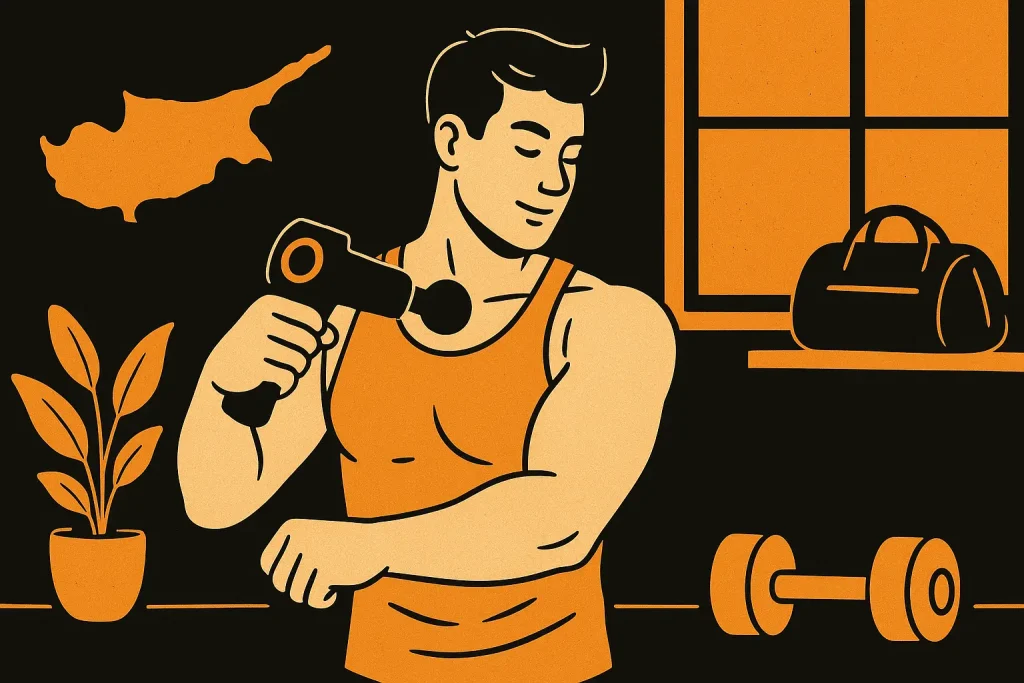
Massage guns use percussive therapy to target deep muscle tissue. The rapid pulses increase blood flow, reduce muscle tension, and break up knots.
Think of it as a deep tissue massage you control yourself. No appointment needed. No awkward small talk with a therapist.
For Cyprus’s active community, from CrossFit enthusiasts in Limassol to trail runners in Troodos, massage guns offer convenient recovery between training sessions.
The Golden Rules of Safe Massage Gun Use
Before you press that power button, understand these fundamental safety principles.
Rule #1: Never Use on Bones or Joints
This is critical. Massage guns target muscles only.
Never apply them directly to:
- Your spine or vertebrae
- Knee caps or elbows
- Hip bones or shoulder joints
- Your skull or face
- The neck’s front (where your carotid artery is)
Hitting bones or joints with percussive force can cause bruising, inflammation, or worse. Always stay on soft muscle tissue.
Rule #2: Start Low, Go Slow
Don’t crank it to maximum speed on your first use. That’s a recipe for bruising.
Begin with the lowest setting. Gradually increase intensity only if needed. Most people find mid-range speeds perfectly effective.
Rule #3: Keep It Moving
Never hold the massage gun in one spot for more than 10-15 seconds. Constant pressure on one area can damage tissue and cause bruising.
Glide it slowly across the muscle. Think of it like painting with broad strokes, not drilling into one point.
Rule #4: Listen to Your Body
Discomfort? Normal. Sharp pain? Stop immediately.
Massage guns should feel intense but not excruciating. If something hurts badly, you’re either using too much pressure, hitting the wrong area, or the intensity is too high.
Step-by-Step: Using Your Massage Gun Correctly
Let’s break down proper technique for common muscle groups.
For Legs (Post-Workout Recovery)
After those summer runs along Larnaca’s salt lake or gym sessions in Nicosia’s heat:
Quads:
- Use a medium intensity setting
- Glide slowly up and down the muscle
- Spend 1-2 minutes per leg
- Avoid directly over the knee
Hamstrings:
- Sit with leg extended
- Move from upper thigh toward knee
- 1-2 minutes per leg
- Stay on the muscle belly, not behind the knee
Calves:
- Point toes or flex foot to isolate different muscle areas
- Use circular or vertical motions
- 30-60 seconds per calf
- Be gentler here, calf muscles are sensitive
For Upper Body (Desk Work + Training)
Cyprus gym lovers often balance office work with intense training. Your upper body takes a beating from both:
Shoulders:
- Target the meaty part of deltoids
- Avoid the bony shoulder cap
- 30-60 seconds per shoulder
- Great after swimming in Mediterranean waters or overhead pressing
Upper Back:
- Focus on the trapezius muscles
- Keep away from the spine itself
- 1-2 minutes total
- Perfect after those hot, tense days
Chest:
- Use light pressure on pectoral muscles
- Stay away from armpits and ribs
- 30-60 seconds per side
- Helpful after bench pressing
For Lower Back (Use with Caution)
Lower back pain plagues many gym-goers, especially in Cyprus’s heat when dehydration affects muscle function.
Safe approach:
- Target muscles beside the spine, not on it
- Use lowest intensity
- Move very slowly
- Consider having someone help you reach properly
- If you have any back injury, consult a doctor first
Common Mistakes That Lead to Injury
Even experienced athletes make these errors.
Mistake #1: Using It on Injuries
Got a fresh muscle strain? Tendonitis? Recent surgery?
Put the massage gun down. Using percussive therapy on acute injuries can worsen inflammation and delay healing.
Wait until the acute phase passes (usually 48-72 hours minimum). When in doubt, ask a physiotherapist.
Mistake #2: Overuse
More isn’t better. Limit massage gun sessions to 10-15 minutes total per muscle group.
Using it for 30+ minutes or multiple times daily can cause tissue damage, not recovery.
Mistake #3: Replacing Proper Warm-Ups
Massage guns support recovery. They don’t replace dynamic warm-ups before training.
You still need to warm up properly before hitting the gym, especially given Cyprus’s temperature swings between air-conditioned indoors and hot outdoor spaces.
Mistake #4: Ignoring Hydration
Massage guns stimulate circulation and help flush metabolic waste. This process requires adequate hydration.
In Cyprus’s climate, you’re already fighting dehydration. Drink water before and after using your massage gun to support the recovery process.
Who Should Avoid Massage Guns?
These powerful tools aren’t for everyone.
Avoid massage guns if you have:
- Blood clotting disorders
- Varicose veins
- Open wounds or skin infections
- Pregnancy (without doctor approval)
- Cancer or tumors
- Severe osteoporosis
- Recent fractures
If you have any medical conditions, check with your healthcare provider before using percussive therapy.
Choosing the Right Massage Gun for Your Needs
Not all massage guns are created equal. Consider these factors:
Amplitude (stroke length): Deeper penetration for larger muscle groups. Look for 12-16mm for general use.
Battery life: Essential if you’re traveling between Paphos and Ayia Napa for competitions or training camps.
Noise level: Quieter models won’t disturb family or roommates during late-night recovery sessions.
Attachments: Different heads target different muscle groups. Most people need 3-4 basic attachments.
Ready to find the right recovery tool? Explore quality massage guns designed for serious athletes and fitness enthusiasts to compare features and find your perfect match.
Best Practices for Cyprus Gym Lovers
A few local considerations:
Post-outdoor training: After running, cycling, or outdoor workouts in Cyprus’s heat, your muscles are already stressed. Be extra gentle with intensity settings.
Travel-friendly recovery: If you train at multiple gyms or travel between cities, choose portable models with solid battery life.
Summer intensity adjustment: During peak summer months, your muscles may be more fatigued from heat stress. Reduce intensity and duration accordingly.
Combine with stretching: Use the massage gun after training, then follow with proper stretching. This combination works brilliantly for recovery.
The Bottom Line
Massage guns are safe, effective recovery tools when used properly. They won’t replace professional massage therapy, physical therapy, or proper training recovery, but they’re excellent supplementary tools.
Start conservatively. Focus on technique over intensity. Listen to your body’s signals. Stay hydrated.
Most importantly, understand that recovery is part of training, not separate from it. Your massage gun should support your fitness goals, not become another rushed checklist item.
Used correctly, it becomes one of your most valuable training companions. Used carelessly, it’s just an expensive way to bruise yourself.
The choice is yours. Make it a smart one.
Find the right massage gun for your recovery routine in our complete selection of professional-grade massage guns and start recovering smarter, not harder.