Finding the right treadmill for a small home can feel like solving a puzzle. You want effective cardio equipment, but you’re working with limited square footage. That’s when terms like “compact treadmill” and “folding treadmill” start appearing in your searches—and they’re often used interchangeably, which only adds to the confusion.
Here’s the truth: these aren’t necessarily the same thing, and understanding the distinction matters if you’re trying to maximise every inch of your living space. This guide breaks down what each term actually means, how they differ in practice, and which type suits your specific situation.
Definitions: What “Compact” and “Folding” Actually Mean
Let’s clear up the terminology first, because manufacturers don’t always use these labels consistently.
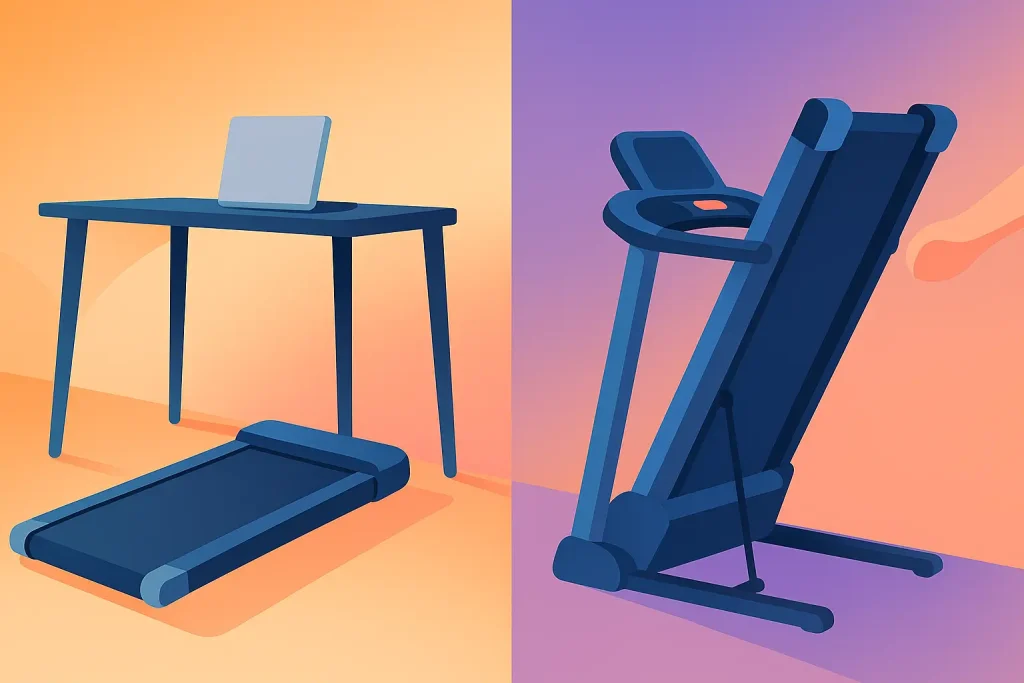
A compact treadmill refers to the overall footprint and proportions of the machine. These treadmills are designed with smaller dimensions from the ground up—typically featuring shorter deck lengths (often 120–140 cm), narrower belts, and reduced overall width and height. Think of “compact” as describing the permanent size of the treadmill, regardless of whether it folds.
A folding treadmill, meanwhile, describes the storage mechanism. These machines have a deck that folds upward (usually hydraulically assisted) so the treadmill occupies less floor space when not in use. Folding treadmills come in all sizes—from full-sized models with 150+ cm decks that fold up, to smaller units that combine both compact dimensions and folding capability.
Here’s where it gets interesting: you can have a compact treadmill that doesn’t fold, and you can have a full-sized folding treadmill that still takes up considerable space even when folded. The key is recognising that these are two different attributes that sometimes overlap.
For anyone searching for a small space treadmill, you’re likely after something that ticks both boxes—compact dimensions and the ability to fold away. But understanding the distinction helps you prioritise what matters most: permanent space savings or flexible storage options.
Size, Deck Length & Footprint: The Numbers That Matter
When you’re comparing compact treadmill vs folding treadmill options, the dimensions tell the real story. Let’s look at what these measurements mean in practice.
Deck length is perhaps the most critical specification. This is the actual running or walking surface, and it directly affects your comfort and stride:
- 100–120 cm: Suitable for walking only; restrictive for anyone over 170 cm tall
- 120–140 cm: Comfortable for walking and light jogging for most users
- 140–150 cm: Accommodates running for average-height users
- 150+ cm: Full-stride running for taller individuals
Compact treadmills typically max out at 130–140 cm deck length, which works well for walking and moderate jogging but can feel cramped for serious runners.
Overall footprint includes the motor housing, console, and frame. Here’s a comparison of typical dimensions:
| Type | Unfolded (L×W×H) | Folded (L×W×H) | Floor Space |
|---|---|---|---|
| Standard folding | 170×80×140 cm | 100×80×140 cm | Large → Medium |
| Compact non-folding | 135×65×125 cm | N/A | Medium (fixed) |
| Compact folding | 130×65×125 cm | 40×65×125 cm | Medium → Small |
| Under-desk compact | 120×55×15 cm | N/A | Small (fixed) |
Notice that a compact non-folding treadmill might actually occupy less permanent floor space than a full-sized folding model, even when the latter is folded up. The folded dimensions still include the entire length of the frame.
Width considerations matter too, especially for doorways and tight corners. Most compact models measure 60–70 cm wide, whilst standard treadmills often exceed 80 cm. If you need to move your treadmill between rooms, measure your narrowest doorway first.
The foldable treadmill dimensions that work for you depend entirely on your available space—both for use and storage. A corner of a bedroom might accommodate a compact folding model beautifully, whilst a dedicated home gym could fit a non-folding compact treadmill that’s always ready to use.
Motor Power & Use Cases: Walking vs Light Running
The motor is the heart of any treadmill, and with compact and folding models, power ratings often reflect their intended use.
Compact treadmills typically feature motors in the 1.0–2.0 continuous horsepower (CHP) range. This is perfectly adequate for:
- Daily walking at 3–6 km/h
- Brisk walking and power walking up to 7 km/h
- Light jogging at 8–10 km/h for users under 80 kg
- Interval training with short running bursts
These motors are designed for efficiency and lower weight rather than maximum power. They run cooler and quieter, which is ideal for flat living, but they’re not built for sustained high-speed running or heavy users.
Folding treadmills span a wider range. Budget folding models might offer similar 1.5–2.0 CHP motors, whilst premium folding treadmills can feature 3.0+ CHP motors capable of serious running. The key difference is that folding mechanism doesn’t inherently limit motor power—it’s just that many manufacturers pair folding designs with compact dimensions and modest motors to target the space-conscious market.
Duty cycle and user weight matter significantly here. A 1.5 CHP motor rated for a 100 kg maximum user weight might handle walking beautifully but struggle with daily running from an 85 kg user. Check the manufacturer’s recommended usage: “light use” typically means under 3 hours per week, “moderate use” is 3–5 hours, and anything beyond that wants a more robust motor.
Incline capability is another consideration. Many compact treadmills offer manual incline (requiring you to stop and adjust by hand) or limited powered incline (perhaps 0–10%). Full-sized models, even folding ones, more commonly feature wider incline ranges up to 15%, which significantly impacts workout intensity.
If your primary goal is walking—whether for gentle exercise, rehabilitation, or working whilst walking—a compact treadmill with a 1.25–1.75 CHP motor serves you well. If you’re a runner, even an occasional one, look for at least 2.5 CHP and verify the continuous (not peak) power rating.
Storage & Portability: Wheels, Gas-Assist & Under-Bed Clearance
Here’s where folding treadmills shine—and where the design details separate the convenient from the frustrating.
Folding mechanisms come in several varieties:
- Hydraulic gas-assist: The deck lifts easily with one hand and lowers in a controlled manner. This is the gold standard for solo users and prevents the deck from slamming down.
- Manual fold with lock: You lift the deck yourself (which can be heavy—20–30 kg) and secure it with a pin or latch. Requires reasonable strength and care.
- Soft-drop systems: A budget-friendly middle ground with some resistance during lowering but requiring more effort to raise.
If you’ll be folding and unfolding your treadmill daily, hydraulic assistance isn’t a luxury—it’s a necessity that prevents strain and makes the process take seconds rather than minutes.
Transport wheels are nearly universal on folding treadmills, usually positioned at the front. These let you tilt the folded treadmill and roll it like a wheelbarrow. However, quality varies enormously:
- Larger wheels (7+ cm diameter) roll smoothly over carpet and thresholds
- Smaller wheels can catch on rugs or require significant force
- Wheel placement affects balance—front-heavy designs tip easily
Compact non-folding treadmills often include transport wheels too, but you’re still moving the full footprint of the machine, which may not fit through doorways or around tight corners.
Under-bed storage is the dream for many flat dwellers, but verify the actual folded height. A treadmill that folds to 130 cm tall won’t fit under a standard bed (typically 35–50 cm clearance). True under-bed models are usually compact walking treadmills with very low profiles—15–20 cm—that don’t fold but slide directly beneath the bed or sofa.
Vertical storage considerations: When folded upright, treadmills can be 130–150 cm tall. Measure your ceiling height and account for lifting the deck above the pivot point. Some compact folding treadmills are designed to fold to just 30–40 cm depth, allowing them to tuck behind a door or in a wardrobe.
Weight is the final portability factor. Compact treadmills typically weigh 25–45 kg, whilst full-sized folding models can exceed 70 kg. If you live alone and plan to move your treadmill regularly, staying under 35 kg makes a significant difference in practicality.
Noise & Vibration: Apartment Considerations
If you’re in a flat with neighbours below, noise isn’t just a preference—it’s a requirement. This is where motor size, build quality, and deck design all come into play.
Motor noise correlates somewhat with power, but engineering matters more. A well-designed 1.75 CHP motor with proper mounting and insulation will run quieter than a cheap 2.5 CHP motor with poor dampening. Compact treadmills often have an advantage here because their lower-powered motors inherently generate less noise, typically operating at 60–70 decibels during use (comparable to normal conversation).
Belt and deck noise comes from the friction and impact of your footfalls. Key factors include:
- Belt quality: Multi-ply belts with good lubrication run more quietly
- Deck cushioning: Shock-absorbing systems reduce impact noise transmitted to the floor
- Roller bearings: Quality bearings are nearly silent; cheap ones squeak and rumble
Folding mechanisms can introduce additional noise points—hinges, hydraulic pistons, and locking mechanisms may creak if poorly maintained. Regular lubrication of moving parts keeps things quiet.
Vibration transfer to the floor is often more problematic than airborne noise. Even a quiet motor creates vibration that can travel through your floor to the flat below. Solutions include:
- Treadmill mats: 6–10 mm thick rubber mats absorb vibration and protect flooring
- Anti-vibration pads: Placed under each foot of the treadmill, these further isolate movement
- Carpet: Actually helps dampen vibration compared to hard floors (though it makes transport wheels less effective)
Compact vs full-sized considerations: Lighter compact treadmills can actually create more vibration relative to their weight because they lack mass to absorb your impact. Heavier machines feel more stable and transfer less proportional vibration, even if their motors are louder. It’s a trade-off.
Walking vs running noise: If you’re primarily walking, noise is rarely an issue regardless of treadmill type. Running creates significantly more impact noise—if this is your primary use case and you have noise-sensitive neighbours, look specifically for models advertised with enhanced cushioning systems, or consider whether outdoor running might be preferable for intensive sessions.
Most quality compact treadmills designed for home use will be acceptably quiet for walking and light jogging in a flat. If you’re uncertain, check reviews specifically mentioning apartment use, and budget £30–50 for a good treadmill mat as standard equipment.
Decision Matrix: Which Is Right for You?
Choosing between compact treadmill vs folding treadmill options—or finding one that combines both—comes down to your specific constraints and priorities. Here’s how to decide:
Choose a compact non-folding treadmill if:
- You have a dedicated space where the treadmill can live permanently
- You want the simplest, most reliable design with fewer moving parts
- Your primary use is walking or light jogging
- You prefer to step on and start without setup time
- You have a budget under £300 and want maximum value
Choose a full-sized folding treadmill if:
- You’re a regular runner who needs a proper 150+ cm deck length
- You have adequate floor space when in use but want occasional storage flexibility
- You need a more powerful motor (2.5+ CHP) for intensive workouts
- You’re willing to invest £500+ for quality engineering
- Storage is helpful but not essential
Choose a compact folding treadmill if:
- You’re in a small flat or bedsit with genuinely limited space
- You need to store the treadmill daily or several times per week
- Walking and moderate jogging cover your fitness goals
- You want the flexibility to reclaim your floor space for other activities
- You’re looking in the £250–600 range for a balanced solution
Choose an under-desk compact treadmill if:
- You work from home and want to walk whilst working
- Maximum walking speed of 6 km/h is sufficient
- You need ultra-low-profile storage (under furniture)
- You’re primarily focused on increasing daily movement rather than dedicated workouts
Red flags to avoid:
- Folding mechanisms without gas-assist if you’ll fold it frequently
- Deck length under 120 cm if you’re over 170 cm tall
- Maximum user weight within 10 kg of your actual weight
- Motors under 1.5 CHP for anyone over 75 kg or planning to jog regularly
- No transport wheels on any folding model
- Missing treadmill mat—always factor this into your budget
The sweet spot for most small-space situations: A compact folding treadmill with a 125–135 cm deck, 1.75–2.25 CHP motor, hydraulic-assist folding, and transport wheels. This combination handles walking to light running for most users, folds away genuinely small, and typically costs £350–500 from reputable manufacturers.
If you’re still uncertain about whether a treadmill will physically fit in your home, taking accurate measurements of both your space and potential models is essential—there’s nothing more frustrating than a treadmill that won’t fit through your door or unfold without hitting furniture.
Ready to find your ideal small-space solution? Browse our full selection of compact treadmills designed specifically for homes and flats where every centimetre counts. Whether you need a folding model for ultimate flexibility or a compact fixed design for simplicity, you’ll find options suited to walking, jogging, and everything in between.
For more guidance on measuring your space and ensuring the perfect fit, see our guide on how to measure for a treadmill in small spaces.