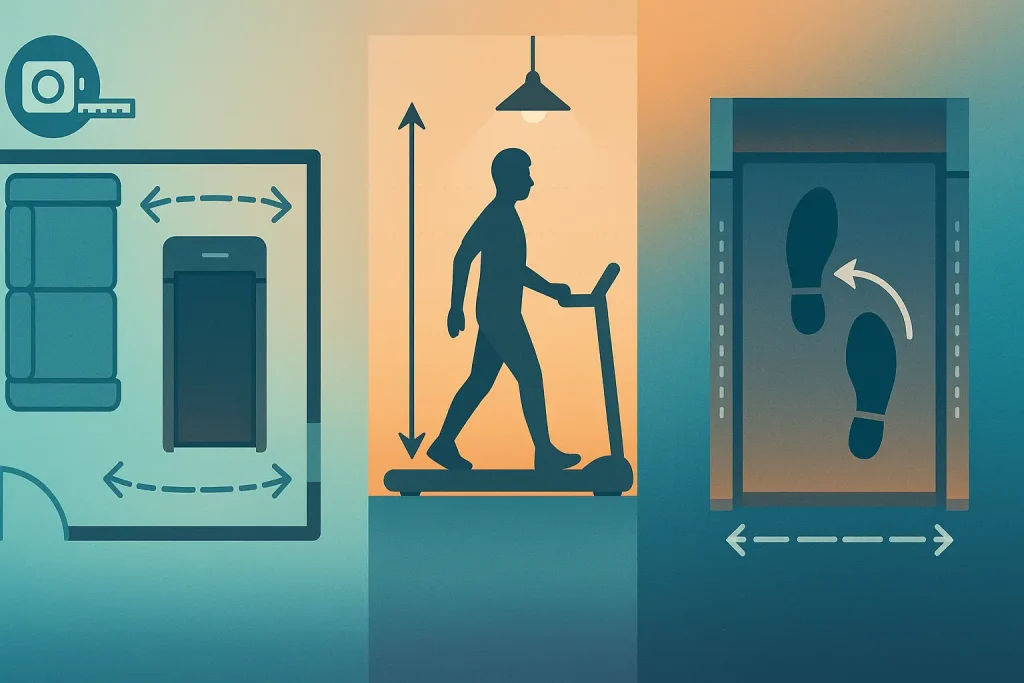
You’ve decided a treadmill would transform your fitness routine. You’ve read the reviews, compared features, and found a compact treadmill for small apartment living that looks perfect. Then it arrives—and doesn’t fit through your bedroom door. Or worse, it fits in the room but you can’t actually use it without rearranging half your furniture.
This happens more often than you’d think, and it’s entirely preventable. The difference between a treadmill that becomes a daily habit and one that becomes an expensive clothes rack often comes down to five minutes of measuring before you buy.
This guide walks you through exactly what to measure, why each dimension matters, and how to ensure your compact treadmill will not only fit in your space but work comfortably within it. We’ll cover everything from doorway widths to ceiling heights, stride lengths to storage clearances—all the measurements that determine whether a treadmill genuinely works in your home.
Quick Measuring Checklist: The Essential Dimensions
Before you look at a single treadmill specification, gather these measurements from your home. You’ll need a tape measure (a 5-metre one is ideal), a notepad, and about ten minutes.
Floor space measurements:
- Primary location (where the treadmill will sit during use): Measure the length and width of your available floor area. Be realistic—account for existing furniture, radiators, and features you can’t move.
- Storage location (if different): If you’re planning to fold and move your treadmill after each use, measure this space separately. Under-bed clearance, behind-door gaps, or wardrobe depths all need precise measurements.
- Doorways and corridors: Measure the width of every doorway the treadmill must pass through to reach its location. Don’t forget to measure the narrowest point, which is often where the door frame projects slightly inward. For corridors, measure width at the narrowest point and note any corners—you’ll need clearance for pivoting.
- Ceiling height: Measure from the floor to the ceiling at the exact spot where you’ll use the treadmill. If you have sloped ceilings, measure at the lowest point above where you’ll be standing.
Access route measurements:
- Stairways: If applicable, measure the width between handrails and the vertical clearance from each step to the ceiling or overhead obstacle. Measure any landings where you’ll need to turn.
- Lifts: Note the interior dimensions if you’ll be using a lift to transport the treadmill to your flat.
Storage and clearance zones:
- Wall clearances: Measure the distance from your intended treadmill location to the nearest walls on all sides. You’ll need space to step on and off safely.
- Overhead obstacles: Note any low-hanging light fixtures, ceiling fans, or exposed beams within 2 metres of your treadmill location.
Write all these measurements down and keep them with you when shopping—either on your phone or printed out. You’ll be comparing them against every treadmill’s specifications, and having them to hand prevents guesswork and costly mistakes.
Ready to start matching your measurements to real models? Browse compact treadmills designed for small spaces, with full dimensions clearly listed so you can verify the fit before buying.
Footprint vs. In-Use Clearance: The Space You Actually Need
Here’s where many buyers trip up: a treadmill’s stated dimensions tell you only part of the story. You need additional clearance around the machine for safe, comfortable use.
Understanding the footprint: When manufacturers list dimensions as something like “135 cm L × 65 cm W”, they’re giving you the absolute physical footprint—the rectangle the treadmill occupies whilst sitting on your floor. This is your minimum space requirement, but it’s rarely sufficient for actual use.
Recommended clearance zones:
- Behind the treadmill: 100–150 cm minimum. This is your safety zone. If you stumble or need to step off quickly, you want clear space behind you, not a wall or furniture. For walking-only use, 100 cm suffices; for running, allow 150 cm.
- In front of the treadmill: 50–75 cm. You need space to step on and off comfortably, particularly when mounting a moving belt. This area should be kept clear of obstacles.
- Sides of the treadmill: 50 cm each side. This allows you to step off to the side rails safely and provides space for air circulation around the motor.
Let’s look at a practical example. A compact treadmill measuring 130 cm × 65 cm requires an actual floor area of approximately:
- Length: 130 cm (treadmill) + 150 cm (rear) + 50 cm (front) = 330 cm total
- Width: 65 cm (treadmill) + 50 cm (left) + 50 cm (right) = 165 cm total
That’s a 3.3 m × 1.65 m rectangle—considerably larger than the treadmill itself.
Reducing clearance requirements: If you’re genuinely tight on space, you can compromise on these guidelines:
- Position the treadmill with the back end toward a wall, reducing rear clearance to 30–50 cm if you only walk at slow speeds and can safely step off the sides.
- Mount against a side wall, eliminating one 50 cm side clearance, but keep the other side clear.
- Use front clearance as your primary mounting space, placing the console end near your room entrance.
Never compromise on: Having at least one completely clear exit route off the treadmill. Whether that’s stepping forward, backward, or to one side, you must have an unobstructed path to solid ground.
Folding considerations: If you’re folding your treadmill for storage, you need temporary clearance to lift the deck. The deck pivots upward and outward, requiring an arc of space. For a 130 cm deck, you’ll need approximately 150–160 cm of clear height and front clearance during the folding process. You don’t need this space permanently, but you do need it every time you fold or unfold the machine.
Visual check: Before committing to a location, use painter’s tape to mark out the treadmill footprint plus clearances on your floor. Live with this taped outline for a day or two. Can you navigate your room comfortably? Does the space feel workable when you’re moving around? This simple exercise often reveals issues that measurements alone might miss.
Ceiling Height Math: Ensuring Adequate Vertical Clearance
Ceiling height is one of the most overlooked measurements, yet it’s critical for comfort and safety. Running on a treadmill adds 5–20 cm to your effective height depending on the machine, your gait, and how you move.
The basic calculation:
Your required ceiling height = Your height + Treadmill deck height + Vertical movement allowance + Comfort buffer
Let’s break down each component:
1. Your height: Straightforward—measure yourself standing normally.
2. Treadmill deck height: This varies by model but typically ranges from:
- Ultra-compact/under-desk models: 10–15 cm
- Standard compact treadmills: 12–18 cm
- Full-featured compact treadmills: 15–22 cm
Find this specification (sometimes called “step-up height” or “deck height”) in the manufacturer’s details.
3. Vertical movement allowance: When you walk or run, your head moves up and down:
- Walking: 3–5 cm of vertical head movement
- Jogging: 5–8 cm
- Running: 8–12 cm
Taller people often have more vertical movement due to longer strides and more pronounced gait patterns.
4. Comfort buffer: Add at least 15–20 cm of clearance above your maximum reach. This prevents the psychological discomfort of feeling you might hit your head and allows for natural arm movement if you don’t use the handrails.
Practical examples:
For a 175 cm tall person walking on a compact treadmill with 15 cm deck height:
- 175 cm (height) + 15 cm (deck) + 5 cm (movement) + 20 cm (buffer) = 215 cm minimum ceiling height
For a 185 cm tall person jogging on the same treadmill:
- 185 cm + 15 cm + 8 cm + 20 cm = 228 cm minimum ceiling height
What if your ceiling is too low?
Standard UK ceiling heights are approximately 230–240 cm in modern flats and 250–270 cm in period properties. If you’re close to the limit:
- Choose a lower-profile treadmill: Under-desk models with 10–12 cm deck heights buy you crucial centimetres.
- Limit your use to walking: Less vertical movement means lower effective height.
- Test before buying: If possible, try a similar model in-store to ensure you feel comfortable.
- Consider your footwear: Thick running shoes add 2–3 cm to deck height.
Sloped ceilings: If you have angled ceilings (common in attic conversions or top-floor flats), measure at the lowest point above where your head will be whilst using the treadmill. You may need to position the treadmill to take advantage of higher sections.
Overhead fixtures: Ceiling fans, pendant lights, or exposed beams effectively reduce your usable ceiling height. Either remove/relocate these fixtures or factor their lowest point into your measurement.
For anyone over 180 cm tall with ceilings below 235 cm, ceiling height deserves careful attention. A treadmill dimensions guide should always include vertical clearance, but many buyers focus solely on floor space and regret it later.
Deck Length & Stride Length: Matching Your Gait
The deck length—the actual belt surface you walk or run on—directly impacts your comfort and safety. Too short, and you’ll feel cramped or risk stepping off the back; too long, and you’re paying for treadmill you don’t need. Getting this measurement right depends on your height, stride length, and intended use.
Understanding stride length:
Your stride length is the distance from the heel of one foot to the heel of the same foot on the next step. It varies by:
- Walking: Generally 40–50% of your height
- Jogging: Typically 50–60% of your height
- Running: Usually 60–70% of your height
For a 175 cm tall person:
- Walking stride: approximately 70–87 cm
- Jogging stride: approximately 87–105 cm
- Running stride: approximately 105–122 cm
Minimum deck length requirements:
A comfortable treadmill deck length should be at least 20–30 cm longer than your typical stride. This provides buffer space so you’re not landing right at the edge of the belt with each step.
| Your Height | Walking | Light Jogging | Running |
|---|---|---|---|
| 150–160 cm | 100 cm+ | 110 cm+ | 120 cm+ |
| 160–170 cm | 110 cm+ | 120 cm+ | 130 cm+ |
| 170–180 cm | 115 cm+ | 125 cm+ | 135 cm+ |
| 180–190 cm | 120 cm+ | 130 cm+ | 140 cm+ |
| 190+ cm | 125 cm+ | 140 cm+ | 150 cm+ |
Most compact treadmills for small apartments feature deck lengths between 100–140 cm, which explains why they’re best suited to walking and light jogging rather than serious running. If you’re over 180 cm and planning to run regularly, you’re approaching the limits of what “compact” can deliver—you may need to consider whether a folding full-sized treadmill (with 150+ cm deck) better serves your needs.
Belt width considerations: While we’re discussing the deck, width matters too. Belt width typically ranges from:
- Ultra-compact: 35–40 cm
- Standard compact: 40–45 cm
- Comfortable compact: 45–50 cm
Wider belts feel more stable and forgiving, particularly for runners with wider gaits or anyone concerned about balance. If you’re between sizes, a wider belt often makes a greater comfort difference than a slightly longer deck.
Testing stride compatibility: If you can visit a shop or gym with treadmills:
- Start walking at your natural pace and notice where your feet land on the belt. You should have 10–15 cm of belt in front of your leading foot at mid-stride.
- Gradually increase speed to your typical jogging pace and repeat the observation.
- If you feel like you’re constantly adjusting your position or consciously shortening your stride, the deck is too short.
Special considerations:
- Rehabilitation or limited mobility: Shorter strides mean you can comfortably use shorter decks—sometimes as little as 100 cm.
- Interval training: If you’ll be alternating between walking and running, size for your running stride.
- Growing children: If young people will use the treadmill, size for their adult stride, not their current height.
The treadmill deck length for stride compatibility is worth getting right. An extra 10 cm of deck length might add £50–100 to the purchase price, but it’s the difference between a treadmill you use daily and one you avoid because it feels awkward.
Weight & Moving Considerations: Portability Factors
A compact treadmill that’s theoretically perfect on paper still needs to physically arrive in your home and potentially move between locations. Weight, manoeuvrability, and handling features all matter enormously for small-space living.
Typical weight ranges:
- Ultra-compact/under-desk: 20–30 kg
- Standard compact treadmill: 30–45 kg
- Feature-rich compact: 45–65 kg
- Folding full-sized: 60–90 kg
Why weight matters:
If you live alone and plan to fold and store your treadmill daily, there’s a world of difference between manoeuvring a 28 kg machine and a 55 kg one. Even with wheels, you’re still tilting and steering the entire weight.
For reference, 25–35 kg is manageable for most adults to tilt and roll solo, whilst anything over 45 kg typically requires more strength or assistance. If you have mobility limitations, back problems, or simply want minimal effort, staying under 35 kg is advisable.
Assembly and delivery:
Most treadmills arrive partially assembled, requiring you to attach the console, handrails, and possibly the deck. The base unit—containing the motor, frame, and belt—is usually the heaviest component and arrives as a single piece.
Consider:
- Stairwells: Can you and a helper safely carry the boxed weight up stairs? A 50 kg treadmill in packaging might weigh 60 kg total.
- Lift capacity: Check your building’s lift weight limit if you’re in a high-rise flat.
- Delivery options: Many retailers offer room-of-choice delivery and assembly services for £50–100—worth considering for heavier models or upper floors.
Movement features to look for:
- Transport wheels: Nearly universal on folding treadmills, these allow you to tilt the unit and roll it. Check:
- Wheel diameter (larger rolls more easily over carpet)
- Wheel placement (affects tipping balance)
- Wheel quality (cheap wheels may break or not roll smoothly)
- Integrated handles: Some treadmills feature grab points or handles specifically for moving. Without these, you’re left gripping the frame or console, which can be awkward.
- Gas-assisted folding: If you’ll fold frequently, hydraulic assistance is essential. It reduces the effective weight you’re lifting from 20–30 kg down to just 3–5 kg of effort.
- Removable components: A few models allow you to detach the console or handrails easily, reducing bulk for transport through tight doorways.
Doorway navigation:
Even with the exact width measurements, moving a bulky treadmill through doorways takes technique:
- Folded treadmills can usually angle through doorways narrower than their unfolded width
- Removing the console may gain crucial centimetres
- Most treadmills can tilt to pass through at an angle
- Doorway height matters—measure the diagonal dimension when tilting
Testing before you buy: If viewing in person, actually try tilting and rolling the display model. Does it tip easily? Do the wheels roll smoothly? Can you steer it comfortably? This hands-on test reveals far more than specifications.
Storage location access:
Finally, consider not just whether the folded treadmill fits your storage spot, but whether you can realistically get it there after each use. A treadmill that tucks beautifully behind your bedroom door is less useful if reaching that spot requires moving your bed every time.
Casters vs fixed feet: Some compact treadmills feature casters (small wheels) on all four corners rather than requiring tilting. These roll more easily but offer less stability during use—a trade-off worth understanding.
For anyone in a small flat, particularly on upper floors or without lift access, weight and portability deserve almost as much attention as the specifications. A lighter, slightly less powerful treadmill you’ll actually use beats a heavier, feature-rich model that stays folded because moving it is too much hassle.
Printable Measuring Worksheet: Your Pre-Purchase Checklist
To make your measuring process straightforward, here’s a comprehensive worksheet covering every dimension you need. Print this page or save it to your phone, then fill in your measurements before shopping.
TREADMILL FIT WORKSHEET
Date: _______________
Room/Location: _______________
FLOOR SPACE MEASUREMENTS
Primary use location:
- Length: _______ cm
- Width: _______ cm
- Notes (furniture, obstacles): _______________________________
Storage location (if different):
- Length: _______ cm
- Width: _______ cm
- Height/Depth: _______ cm
- Access notes: _______________________________
ACCESS ROUTE MEASUREMENTS
Doorway 1 (description: ______________):
- Width: _______ cm
- Height: _______ cm
Doorway 2 (description: ______________):
- Width: _______ cm
- Height: _______ cm
Doorway 3 (description: ______________):
- Width: _______ cm
- Height: _______ cm
Narrowest corridor width: _______ cm
Stairwell width (if applicable): _______ cm
Lift interior dimensions (if applicable): _______ × _______ cm
VERTICAL MEASUREMENTS
Ceiling height at treadmill location: _______ cm
Lowest ceiling point (if sloped): _______ cm
Overhead obstacles:
- Light fixture height: _______ cm
- Other (describe): _______ cm
USER MEASUREMENTS
Primary user height: _______ cm
Secondary user height (if applicable): _______ cm
Intended use (tick all that apply): ☐ Walking (up to 6 km/h) ☐ Brisk walking/power walking (6–8 km/h)
☐ Light jogging (8–10 km/h) ☐ Running (10+ km/h)
CLEARANCE CALCULATIONS
Based on primary use location:
Available rear clearance: _______ cm
(Recommended: 100–150 cm)
Available front clearance: _______ cm
(Recommended: 50–75 cm)
Available left side clearance: _______ cm
(Recommended: 50 cm)
Available right side clearance: _______ cm
(Recommended: 50 cm)
TREADMILL REQUIREMENTS
Based on above measurements:
Maximum treadmill length: _______ cm
Maximum treadmill width: _______ cm
Maximum folded dimensions: _______ × _______ × _______ cm
Minimum deck length needed: _______ cm
(Use stride length guide above)
Maximum treadmill weight: _______ kg
(Consider who will move it)
DEAL-BREAKERS
Note any absolute constraints:
☐ Must fit through _______ cm doorway ☐ Must fold to under _______ cm for storage ☐ Must weigh less than _______ kg ☐ Cannot exceed _______ cm width ☐ Must have wheels/casters ☐ Other: _______________________________
SHOPPING NOTES
Models being considered:
- _______________ (dimensions: _______________)
- _______________ (dimensions: _______________)
- _______________ (dimensions: _______________)
Fits my space? ☐ Yes ☐ No ☐ Unsure
Fits my stride? ☐ Yes ☐ No ☐ Unsure
Can access/move? ☐ Yes ☐ No ☐ Unsure
Final verification before purchase:
☐ Treadmill dimensions fit my use location with adequate clearance
☐ Treadmill fits through all doorways and access routes
☐ Deck length suits my height and intended use
☐ Ceiling height provides comfortable vertical clearance
☐ Weight is manageable for my moving/storage needs
☐ Folded dimensions fit my storage space (if applicable)
Take this worksheet with you when shopping online or in person. Having precise measurements eliminates guesswork and prevents the disappointment of a treadmill that doesn’t quite fit. If you’re shopping online, keep digital photos of your measurements on your phone for easy reference.
Need help interpreting your measurements? Understanding the terminology differences between compact and folding treadmills can clarify which type best suits your space constraints—see our complete comparison guide for detailed definitions.
Once you’ve confirmed your measurements, browse compact treadmill models with full specifications, so you can verify every dimension before buying.
Getting the measurements right transforms treadmill shopping from stressful guesswork into a straightforward matching exercise. With your completed worksheet in hand, you’ll shop with confidence, knowing that what you order will genuinely work in your space—no surprises, no regrets, and no expensive returns.