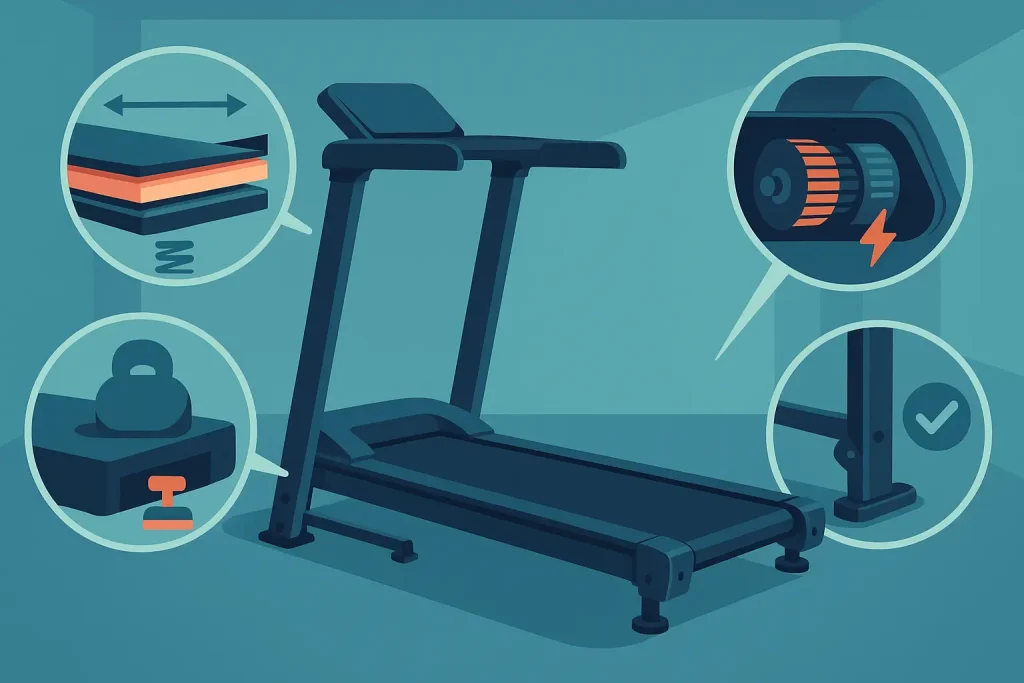
Finding a treadmill that’s both genuinely compact and built to support heavier users feels like searching for a unicorn.
Most compact treadmills max out at 100–120 kg (220–265 lb) capacity, leaving larger-framed individuals, taller users, or anyone over 90 kg with few small-space options. The assumption seems to be that if you need a robust treadmill, you must have room for a full-sized machine.
That’s not always the case. Plenty of people need a compact treadmill 300 lb capacity or higher because they live in flats, bedsits, or homes where space is simply limited—regardless of their size or fitness level. The good news is that high weight capacity treadmill small space options do exist, but they require careful specification checking to separate genuinely heavy-duty machines from those that simply claim higher limits without the engineering to back them up.
This guide explains exactly what to look for in a heavy duty compact treadmill: the motor power, frame construction, deck specifications, and warranty coverage that indicate a machine built to last under higher loads. We’ll also walk through real-world configurations that successfully combine compact dimensions with serious weight capacity, so you know what’s actually achievable.
Minimum Specs to Expect: Weight Limit, Motor Power & Frame Construction
Not all weight capacity ratings are created equal. A treadmill that claims to support 136 kg (300 lb) but wobbles under 90 kg isn’t genuinely heavy-duty—it’s optimistically rated marketing. Here’s what the specifications should actually look like for a legitimate high-capacity compact treadmill.
Weight capacity ratings:
Manufacturers typically list a maximum user weight, but understanding what this means matters:
- Maximum capacity: The absolute limit before potential damage or safety concerns. This should never be your actual weight—you need headroom.
- Comfortable working capacity: Realistically about 10–15 kg below maximum for everyday use without excessive strain on components.
- Dynamic load tolerance: When running, your impact force can be 2.5–3× your body weight with each footfall. A treadmill rated for 136 kg experiences approximately 340+ kg of force during running.
For genuine heavy-duty performance, look for these minimum weight capacity ratings:
- Walking only: 136 kg (300 lb) minimum capacity
- Walking and jogging: 150 kg (330 lb) minimum capacity
- Running: 160+ kg (350+ lb) minimum capacity
Motor specifications:
The motor bears responsibility for moving both the belt and the user’s weight. Underpowered motors on heavy-duty treadmills overheat, wear quickly, and struggle to maintain consistent speed.
Minimum continuous horsepower (CHP) for higher weight capacity:
- 136 kg capacity: 2.0–2.5 CHP minimum
- 150 kg capacity: 2.5–3.0 CHP minimum
- 160+ kg capacity: 3.0+ CHP minimum
Note the emphasis on continuous horsepower, not peak. Peak HP ratings (sometimes inflated to 4.0 or 5.0 HP) measure brief maximum output, whilst CHP indicates sustained performance—the number that actually matters for daily use.
Why motor power matters for heavier users: Beyond just moving more weight, larger users often have longer strides and higher impact forces. A robust motor maintains consistent belt speed despite varying load, prevents slowdown during footstrike, and runs cooler under sustained use.
Frame construction:
The frame is the skeleton that holds everything together. Heavy-duty frames feature:
- Steel gauge thickness: Look for 1.5–2.0 mm steel tubing or thicker. Budget treadmills often use 1.0–1.2 mm steel that flexes under load.
- Welded vs bolted construction: Welded frames offer superior strength and rigidity. Bolted frames can work but may develop play or loosening over time.
- Cross-member support: Additional horizontal or diagonal bracing prevents lateral flexing and twisting during use.
- Wider stance: Heavy-duty treadmills typically feature wider base dimensions (70–80 cm) for improved stability, even if the overall footprint remains compact.
Deck and roller specifications:
The deck (the board beneath the belt) and rollers (the drums the belt wraps around) directly affect durability:
- Deck thickness: 15–20 mm minimum for heavier users; 20–25 mm is better. Thicker decks resist warping and provide more stable support.
- Deck material: Multi-ply wood construction, sometimes with phenolic resin coating for durability and reduced friction.
- Roller diameter: 5 cm minimum; 6–7 cm is preferable. Larger rollers reduce belt stress and bearing wear.
- Roller bearings: Sealed precision bearings rated for continuous heavy-duty use.
Shock absorption system:
Heavier users generate more impact force, making quality cushioning essential for:
- Joint protection (knees, hips, ankles)
- Noise reduction (important in flats)
- Deck longevity (cushioning absorbs force that would otherwise stress the deck)
Look for multi-point cushioning systems (cushioning elements positioned along the deck length) rather than simple rubber grommets.
Real-world quality indicators:
When specifications aren’t comprehensive, these details suggest genuine heavy-duty construction:
- Unit weight over 45 kg (heavier machine = more substantial materials)
- Warranty over 2 years on frame (manufacturers confident in durability)
- Motor warranty 2+ years (indicates quality components)
- Commercial-grade designation (even if for light commercial use).
Deck Length vs. Stability: The Compact Treadmill Balancing Act
Here’s the challenge with compact high-capacity treadmills: the very features that make them compact (shorter length, lighter weight, smaller footprint) work against the stability and comfort that heavier users need. Understanding this trade-off helps you make informed compromises.
Deck length for heavier users:
We covered stride length calculations in our complete measuring guide, but heavier users face additional considerations:
- Proportional stride: Taller, larger-framed individuals typically have longer strides. A 190 cm tall person weighing 120 kg likely has walking strides of 90–100 cm and jogging strides exceeding 110 cm.
- Deck utilisation: Heavier users often prefer positioning themselves slightly forward of centre-deck for improved balance, effectively reducing usable deck length by 5–10 cm.
- Safety margin: With higher impact forces, having adequate deck length prevents accidentally stepping off the rear of the belt—especially during speed changes or fatigue.
Realistic deck length requirements for heavier users:
| User Height | Weight Range | Walking Minimum | Jogging Minimum |
|---|---|---|---|
| 170–180 cm | 90–110 kg | 120 cm | 130 cm |
| 180–190 cm | 90–120 kg | 125 cm | 135 cm |
| 190+ cm | 90–120 kg | 130 cm | 140 cm |
| Any height | 120+ kg | Add 5–10 cm | Add 10 cm |
Notice these minimums are 5–10 cm longer than recommendations for lighter users of the same height. The extra length provides psychological comfort and practical safety.
The stability equation:
Stability depends on several interconnected factors:
1. Base width: Wider treadmills (70+ cm external width) feel more stable than narrow ones (60–65 cm). For compact models, this often means accepting slightly greater width to gain stability.
2. Weight distribution: Heavier treadmills resist shifting and feel more planted. A 55 kg compact treadmill feels more stable under a 100 kg user than a 35 kg model, even with identical specifications otherwise.
3. Centre of gravity: Shorter treadmills have proportionally higher centres of gravity, making them more prone to tipping if unevenly loaded. Heavier users should verify the treadmill has:
- Anti-tip feet or stabilisers
- Balanced motor and flywheel placement
- Wide footprint relative to height
4. Belt tension and tracking: Proper belt tension prevents slippage under high loads. Under-tensioned belts on budget treadmills may slip or stutter during heavy footstrikes.
Compact vs stability: practical limits
There’s a genuine physics limit to how compact a truly stable, high-capacity treadmill can be. Here’s the reality:
- Minimum practical footprint: Approximately 125 cm length × 70 cm width for treadmills rated 136+ kg
- Minimum practical weight: 45–50 kg for adequate stability under higher user weights
- Maximum fold compactness: Folded dimensions typically 130–140 cm tall × 70 cm wide × 30–50 cm deep
Anything claiming to be significantly smaller whilst supporting 136+ kg warrants scepticism. Ultra-compact under-desk treadmills occasionally rate for higher weights, but they’re walking-only machines with completely different use cases.
Testing stability before purchase:
If possible, physically test a treadmill by:
- Standing on the stationary belt and shifting your weight side to side—does the unit feel solid?
- Starting the belt and performing several walking strides—does it feel planted or like it might shift?
- Increasing to jogging speed (if that’s your intended use)—does lateral stability remain confident?
- Stepping deliberately to one side rail—does the unit tilt or stay level?
Poor stability isn’t just uncomfortable—it’s dangerous. A treadmill that rocks, shifts, or feels tippy undermines confidence and increases injury risk.
Compensating for compact dimensions:
If you must choose a more compact model:
- Use a thick rubber mat (8–10 mm) to increase friction and reduce movement
- Position the treadmill with at least one side against a wall for psychological security
- Ensure your ceiling height accommodates a wider stance if needed (feet placed slightly wider than natural for added balance)
- Accept that running may not be advisable—stick to walking and brisk walking
For heavier users, stability often trumps ultimate compactness. A treadmill that’s 10 cm longer but feels secure beats one that’s technically more compact but creates anxiety during use.
Warranty & Service Considerations: Protecting Your Investment
A heavy-duty compact treadmill represents a significant investment—typically £500–1,200+ for legitimate high-capacity models. Warranty coverage and access to service directly affect the long-term value and reliability of that investment.
What warranty terms reveal about quality:
Manufacturers structure warranties to reflect their confidence in durability. Longer coverage periods signal better engineering and higher-quality components.
Standard warranty structure:
Treadmills typically segment coverage into:
- Frame/structure: 5–10 years (sometimes lifetime) for heavy-duty models
- Motor: 2–5 years for quality motors; 1 year or less suggests budget components
- Parts (electronics, belt, rollers, etc.): 1–3 years
- Labour: 1–2 years (covers technician service calls)
Minimum warranty for heavy-duty compact treadmills:
- Frame: 5+ years minimum
- Motor: 2+ years minimum
- Parts: 1+ year minimum
- Labour: 1 year minimum
Red flags:
- 90-day warranties (essentially just covering DOA units)
- No motor coverage beyond 1 year
- Frame warranty under 3 years
- “Parts only” coverage with no labour included
Short warranties often indicate manufacturers expect early failures or plan for a disposable product lifecycle—neither suits heavier users who depend on long-term reliability.
Weight capacity and warranty implications:
Some manufacturers void warranties if the user exceeds stated weight limits—even if damage occurs for unrelated reasons. Before purchasing:
- Read the warranty terms thoroughly, not just the coverage duration
- Verify weight limit enforcement: Does the warranty specifically exclude use by individuals over the rated capacity?
- Understand “abuse” clauses: Vague language about “improper use” sometimes gives manufacturers warranty denial flexibility
For users near the stated maximum capacity, consider choosing a treadmill rated 10–15 kg higher than your weight to stay comfortably within warranty protection.
Service access and costs:
Warranty coverage means little if you cannot actually obtain service. Investigate:
1. Service network: Does the manufacturer have authorised repair technicians in the UK? National brands typically offer better coverage than imported models from lesser-known manufacturers.
2. In-home service: For heavy treadmills, in-home warranty service is essential. Shipping a 60 kg treadmill to a repair depot is expensive (£50–100+ each direction) and impractical.
3. Parts availability: Can you purchase replacement belts, rollers, or electronics directly? Availability of consumable parts (belt, lubricant) matters for long-term maintenance.
4. Response time: What’s the typical wait for a warranty service call? Premium brands often respond within 48–72 hours; budget brands may take weeks.
Extended warranty considerations:
Retailers frequently offer extended warranties (typically £50–150 for 1–3 additional years). These can be worthwhile for:
- First-time treadmill buyers uncertain about durability
- Users planning intensive daily use
- Models near your budget limit where replacement would be difficult
However, extended warranties are poor value if:
- The base warranty already covers 5+ years on critical components
- The retailer has poor service reputation
- The cost exceeds 15% of the treadmill price
Registration and documentation:
To protect your warranty rights:
- Register your treadmill immediately upon delivery (online registration is typically required)
- Retain proof of purchase (receipt or order confirmation)
- Document assembly: Photos of packaging and initial setup help if you need to prove damage wasn’t user-caused
- Keep maintenance records: Log your maintenance (belt lubrication, tension adjustments) as some warranties require documented upkeep
Realistic warranty expectations:
Even with excellent warranties, understand what’s covered and what isn’t:
Typically covered:
- Motor failure under normal use
- Frame cracks or structural defects
- Electronics malfunctions (console, speed controller)
- Premature belt or roller wear (within specified timeframes)
Typically NOT covered:
- Belt wear from inadequate lubrication (maintenance issue)
- Damage from moving or improper storage
- Wear items beyond specified lifespan (belts often last 3,000–5,000 km)
- Damage from power surges (use a surge protector)
Quality of life features:
Beyond warranty terms, some manufacturers offer:
- 30-day trial periods: Use the treadmill at home and return if unsuitable (minus return shipping)
- Setup/assembly services: Professional assembly ensures correct setup
- Direct customer support: Phone or chat support for troubleshooting before invoking warranty
These conveniences particularly matter for larger, heavier treadmills that are difficult to return or service yourself.
For heavier users, a comprehensive warranty backed by accessible service network may justify spending £100–200 more on a reputable brand versus a cheaper model with minimal coverage. Your treadmill needs to last—proper warranty protection ensures it can. For guidance on maintaining your treadmill to maximise its lifespan and warranty compliance, our maintenance guide covers essential upkeep routines.
Example Configurations: Heavy-Duty Compact Treadmills That Deliver
To make specifications concrete, let’s examine real-world configuration profiles that successfully combine compact dimensions with legitimate high-capacity performance. These examples represent the types of specifications and features to target, illustrating what’s actually achievable in the heavy-duty compact category.
Configuration 1: The Walking Specialist
Profile: Maximum compactness with 136 kg (300 lb) capacity for dedicated walking
Key specifications:
- Dimensions: 130 cm L × 68 cm W × 125 cm H
- Folded: 45 cm L × 68 cm W × 135 cm H
- Weight: 48 kg
- Deck length: 120 cm
- Belt width: 45 cm
- Motor: 2.25 CHP continuous
- Weight capacity: 136 kg (300 lb)
- Max speed: 10 km/h
- Incline: 0–8% (manual adjustment)
- Shock absorption: 6-point cushioning system
- Warranty: Frame 10 years, motor 3 years, parts 2 years
Why this configuration works:
This represents the smallest practical footprint for 136 kg capacity. The 120 cm deck limits use to walking and gentle jogging, but that’s acceptable for many users—particularly those focused on daily walking exercise, rehabilitation, or working-while-walking scenarios.
The 2.25 CHP motor provides adequate power for walking at any incline without strain. At 48 kg, the unit offers reasonable stability whilst remaining moveable by most users. Six-point cushioning distributes impact force effectively, protecting joints and reducing noise transmission to neighbours.
The manual incline keeps costs down whilst still offering workout variety. The 10-year frame warranty signals manufacturer confidence in structural durability under rated loads.
Best for: Users up to 125 kg primarily walking, in flats or small homes where absolute minimum footprint matters, with ceiling heights of 220+ cm.
Configuration 2: The Balanced All-Rounder
Profile: Moderate compactness with 150 kg (330 lb) capacity for walking through light running
Key specifications:
- Dimensions: 140 cm L × 72 cm W × 130 cm H
- Folded: 50 cm L × 72 cm W × 142 cm H
- Weight: 58 kg
- Deck length: 132 cm
- Belt width: 48 cm
- Motor: 2.75 CHP continuous
- Weight capacity: 150 kg (330 lb)
- Max speed: 16 km/h
- Incline: 0–12% (powered)
- Shock absorption: 8-point cushioning + deck flex technology
- Warranty: Frame lifetime, motor 5 years, parts 3 years, labour 2 years
Why this configuration works:
This strikes an excellent balance between compact dimensions and robust performance. The 132 cm deck accommodates jogging for most users under 185 cm tall, whilst the 150 kg capacity provides comfortable headroom for users up to 135 kg.
The 2.75 CHP motor handles running at moderate speeds without overheating. Powered incline adds training versatility without requiring stopping to adjust manually. At 58 kg, the unit remains stable during use whilst still being manageable for repositioning with assistance.
Eight-point cushioning plus deck flex technology provides premium joint protection—particularly important for heavier users whose joints bear greater load. The comprehensive warranty, including lifetime frame coverage, indicates commercial-grade construction quality.
Best for: Users 90–135 kg planning mixed walking/jogging workouts, in small-to-medium spaces, who value long-term investment in a versatile machine.
Configuration 3: The Heavy-Duty Runner
Profile: Near-full-sized compact with 160 kg (350 lb) capacity for serious running
Key specifications:
- Dimensions: 150 cm L × 78 cm W × 135 cm H
- Folded: 58 cm L × 78 cm W × 148 cm H
- Weight: 68 kg
- Deck length: 142 cm
- Belt width: 50 cm
- Motor: 3.25 CHP continuous (4.0 HP peak)
- Weight capacity: 160 kg (350 lb)
- Max speed: 18 km/h
- Incline: 0–15% (powered, quick-adjust buttons)
- Shock absorption: Commercial-grade multi-point system with adjustable cushioning
- Warranty: Frame lifetime, motor 5 years, parts 5 years, labour 3 years
Why this configuration works:
This pushes the boundaries of what “compact” means, but represents the minimum specifications for heavier users who genuinely want to run. The 142 cm deck accommodates running strides for users up to 185 cm tall, whilst the 160 kg capacity suits users up to 145 kg comfortably.
The robust 3.25 CHP motor delivers consistent power through high-speed intervals. The 68 kg weight ensures stability even during vigorous running by heavier users. The 50 cm belt width provides confident lateral space.
Adjustable cushioning lets users fine-tune impact absorption—firmer for responsive running feel, softer for joint protection. Commercial-grade components and extensive warranty coverage reflect construction designed for intensive daily use.
The trade-off: at 150 cm length and 68 kg weight, this is “compact” primarily in comparison to full commercial treadmills (typically 180–200 cm long, 90+ kg). It still requires significant space and isn’t trivially moved.
Best for: Serious runners 100–145 kg in small-to-medium dedicated workout spaces, who need genuine running capability without full commercial treadmill dimensions.
Configuration 4: The Apartment-Friendly Compromise
Profile: Noise-conscious design with 140 kg (308 lb) capacity for multi-storey buildings
Key specifications:
- Dimensions: 135 cm L × 70 cm W × 128 cm H
- Folded: 48 cm L × 70 cm W × 138 cm H
- Weight: 52 kg
- Deck length: 127 cm
- Belt width: 46 cm
- Motor: 2.5 CHP continuous (brushless, low-noise design)
- Weight capacity: 140 kg (308 lb)
- Max speed: 14 km/h
- Incline: 0–10% (powered)
- Shock absorption: Enhanced multi-layer cushioning optimised for noise reduction
- Warranty: Frame 5 years, motor 3 years, parts 2 years
Why this configuration works:
This prioritises quiet operation for flat dwellers whilst maintaining meaningful weight capacity. The brushless motor and enhanced cushioning significantly reduce operational noise—critical for users with neighbours above or below.
The 127 cm deck suits walking through moderate jogging for most users. The 140 kg capacity accommodates users up to 125 kg comfortably. At 52 kg, the machine balances stability with reasonable portability.
The powered incline to 10% provides workout variation whilst keeping the design simpler and quieter than high-incline models. The compact folded profile (48 cm deep) allows storage against walls or in wardrobes.
Best for: Users 90–125 kg in flats or terraced houses prioritising quiet operation, with primary focus on walking and jogging rather than high-speed running.
Configuration 5: The Budget-Conscious Option
Profile: Entry-level pricing with 136 kg (300 lb) capacity
Key specifications:
- Dimensions: 128 cm L × 65 cm W × 122 cm H
- Folded: 42 cm L × 65 cm W × 132 cm H
- Weight: 42 kg
- Deck length: 118 cm
- Belt width: 42 cm
- Motor: 2.0 CHP continuous
- Weight capacity: 136 kg (300 lb)
- Max speed: 12 km/h
- Incline: 0–5% (manual, 3 positions)
- Shock absorption: Basic 4-point cushioning
- Warranty: Frame 3 years, motor 2 years, parts 1 year
Why this configuration works:
This represents the minimum viable specifications for higher-capacity users on tight budgets (typically £400–550). The 136 kg capacity suits users up to 120 kg for walking-focused use.
The shorter 118 cm deck and narrower 42 cm belt limit comfort and versatility, but function adequately for walking by users under 180 cm tall. The 2.0 CHP motor handles walking well but may strain during extended jogging by heavier users.
At 42 kg, the unit is lighter and potentially less stable than heavier alternatives, but more easily moved and stored. Manual incline and basic cushioning reduce manufacturing costs whilst retaining essential functionality.
The shorter warranty reflects budget construction, but 2 years on the motor and 3 on the frame still provide reasonable protection.
Best for: Budget-conscious buyers up to 120 kg, primarily walking, who need basic compact functionality without premium features. Accept this as an entry point rather than a long-term solution.
Common threads across configurations:
Notice these patterns in successful heavy-duty compact treadmills:
- None dip below 2.0 CHP motor power for 136+ kg capacity
- Unit weight stays above 42 kg for adequate stability
- Belt width remains 42+ cm for confident footing
- Deck length scales with intended use: 118–127 cm for walking, 130–142 cm for running
- Warranties reflect quality: Budget models offer 2–3 years; premium models provide 5+ years
These configurations prove that high weight capacity treadmill small space options genuinely exist across price points and feature sets—but they require realistic expectations about dimensions, weight, and the trade-offs inherent in combining compact size with robust construction.
Final Considerations for Heavy-Duty Compact Treadmill Buyers
Choosing a compact treadmill with adequate weight capacity requires balancing multiple constraints: space limitations, structural requirements, budget realities, and performance expectations. Here’s how to approach the decision systematically.
Prioritise your non-negotiables:
List your absolute requirements:
- Minimum weight capacity (with 10–15 kg headroom above your weight)
- Maximum footprint dimensions (both unfolded and folded)
- Intended use (walking only, or jogging/running)
- Budget ceiling
These non-negotiables narrow your options to realistic candidates.
Accept that “compact” is relative:
For heavier users, a 140–150 cm treadmill is compact—even if it’s larger than ultra-compact models designed for lighter users. Focus on finding the smallest machine that safely supports your needs, rather than chasing the absolute smallest dimensions.
Plan for proper setup:
Heavy-duty treadmills benefit from:
- Quality placement mat: 8–10 mm thickness, extending 30 cm beyond treadmill perimeter
- Dedicated circuit: Powerful motors (2.5+ CHP) draw significant current; avoid sharing circuits with other high-draw appliances
- Levelling: Use adjustable feet to ensure the treadmill sits perfectly level, preventing uneven wear and vibration
Maintenance commitments:
Higher-capacity treadmills require diligent maintenance:
- Belt lubrication every 40–50 hours of use (heavier users increase friction)
- Regular belt tension checks (heavy loads can stretch belts faster)
- Bolt tightening inspections every 2–3 months (vibration loosens fasteners)
Proper maintenance extends lifespan and maintains warranty validity. Our comprehensive maintenance guide provides specific schedules and procedures.
Try before you buy:
If possible, test similar models in fitness shops or gyms:
- Stand on the deck—does it feel solid?
- Walk at your typical pace—does the belt feel responsive?
- Note noise levels—will this work in your living situation?
Even testing a different brand with similar specifications provides valuable insight into whether compact high-capacity treadmills suit your needs.
Consider the alternatives:
If you cannot find a compact treadmill that genuinely meets your needs:
- Folding full-sized treadmills offer more stability and deck length, folding to moderate storage sizes
- Gym memberships eliminate equipment constraints entirely
- Outdoor exercise combined with strength training at home may better suit your situation
Sometimes the right answer is accepting that a compact treadmill cannot deliver what you need, and exploring other solutions.
The bottom line:
Heavy-duty compact treadmills exist and serve many users well, but they occupy a niche with inherent compromises. Success requires:
- Realistic expectations about dimensions and weight
- Investment in quality components and construction
- Careful specification checking before purchase
- Commitment to proper maintenance
For heavier users navigating space constraints, the right high-capacity compact treadmill transforms home fitness from impossible to achievable. Take the time to find one genuinely engineered for your needs—your joints, your schedule, and your long-term health will thank you.