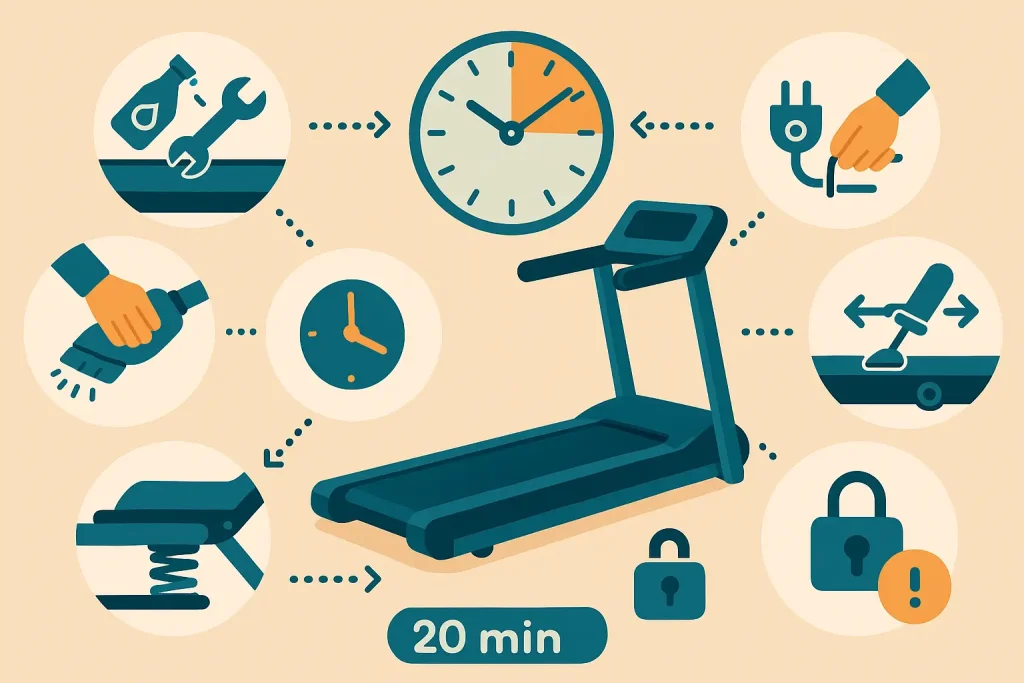
A treadmill that worked perfectly when you unboxed it can develop squeaks, slips, and wobbles within months—or run smoothly for years. The difference isn’t luck; it’s maintenance. Yet most compact treadmill owners never lubricate the belt, check tension, or clean the motor housing until something goes wrong.
Here’s the reality: twenty minutes of monthly compact treadmill maintenance prevents hundreds of pounds in repairs, extends your machine’s lifespan by years, and keeps it running quietly enough for apartment living. This isn’t complicated mechanical work—it’s simple checks and basic upkeep that anyone can do with household tools.
This guide provides a complete maintenance system: pre-use safety checks you can do in two minutes, monthly tasks that take under twenty minutes, and troubleshooting solutions for common noise issues. We’ve also included a printable checklist so you can track your maintenance schedule without guesswork.
Pre-Use Safety Checks: Your Two-Minute Routine
Before every workout—or at minimum, weekly—perform these quick safety checks. They take under two minutes and catch problems before they become dangerous or costly.
1. Emergency stop function
Test the safety key or emergency stop button:
- Attach the safety clip to your clothing
- Start the belt at low speed
- Pull the safety key or clip—the belt should stop immediately (within 1–2 seconds)
- If there’s any delay or the belt continues running, do not use the treadmill until the safety system is repaired
2. Belt alignment and tracking
With the treadmill off, visually inspect the belt:
- Stand at the rear and check if the belt runs centrally between the side rails
- The belt should sit evenly with 5–7 cm of deck visible on each side
- If the belt has shifted significantly to one side, it needs adjustment (covered below)
3. Power cord and connections
Check the power cable:
- No fraying, exposed wires, or damage to the plug
- Secure connection to both the treadmill and wall socket
- No unusual warmth at the plug (indicating loose connection or overload)
4. Deck and frame stability
Place both hands on the handrails and gently rock the treadmill:
- No excessive movement or looseness
- All bolts and connections should feel tight
- The frame shouldn’t creak or flex noticeably
5. Walking belt condition
Run your hand along the belt surface (with power off):
- Surface should feel smooth without significant fraying or wear spots
- Check for any objects or debris trapped between belt and deck
- Belt should move smoothly when pulled by hand, without catching or sticking
6. Console and controls
Power on the console and verify:
- Display illuminates properly
- All buttons respond correctly
- Speed and incline controls function smoothly
- No error codes or warning messages
If any check reveals problems, address them before using the treadmill. Using damaged equipment risks injury and accelerates wear.
Monthly Maintenance Tasks: The 20-Minute Routine
Set a monthly reminder—the first Sunday of each month, or whichever schedule works—and complete these tasks. Consistent maintenance prevents 90% of common treadmill problems.
Task 1: Clean the belt and deck (5 minutes)
Dust, dirt, and debris accelerate belt wear and increase friction:
- Unplug the treadmill
- Vacuum around and beneath the treadmill, including motor housing vents
- Wipe the belt surface with a slightly damp cloth (water only—no cleaners that leave residue)
- Use a dry microfibre cloth to clean the side rails and deck edges
- Wipe the console and handrails with disinfectant suitable for electronics
Task 2: Check and adjust belt tension (5 minutes)
Proper tension prevents slipping whilst avoiding excess motor strain:
Testing tension:
- Stand on the belt (power off)
- Try to lift the belt edge at the centre point—you should be able to raise it 5–7 cm from the deck
- If you can lift it more than 7 cm, it’s too loose
- If you can barely lift it 3–4 cm, it’s too tight
To tighten treadmill belt:
- Locate the rear roller bolts (usually Allen/hex bolts at the back corners)
- Using the appropriate hex key, turn the right bolt clockwise 1/4 turn
- Turn the left bolt clockwise 1/4 turn (equal adjustment maintains alignment)
- Test the belt by walking at 4–5 km/h—it shouldn’t slip under your stride
- Repeat in 1/4-turn increments if needed, testing after each adjustment
To loosen belt: Follow the same process but turn bolts counter-clockwise. Never over-tighten—excess tension strains the motor and rollers.
Task 3: Belt alignment check (3 minutes)
If the belt has drifted left or right:
- Start the treadmill at 3–4 km/h with no one on it
- If the belt drifts right: tighten the right rear roller bolt 1/4 turn
- If the belt drifts left: tighten the left rear roller bolt 1/4 turn
- Let the belt run for 2–3 minutes and observe—it should centre itself gradually
- Make additional small adjustments if needed
Never adjust more than 1/4 turn at a time. Large adjustments cause overcorrection.
Task 4: Lubricate the belt (5 minutes, every 2–3 months)
Follow your manufacturer’s treadmill belt lubrication schedule—typically every 40–50 hours of use or every 2–3 months for average users. Use only silicone-based treadmill lubricant (100% silicone oil), never WD-40 or household oils.
Lubrication process:
- Unplug the treadmill
- Loosen the belt slightly if needed for access
- Lift one edge of the belt at the centre point
- Apply lubricant in a zigzag pattern along the deck surface (amount varies by manufacturer—typically 30–50 ml)
- Repeat on the other side
- Distribute the lubricant by running the belt at low speed for 3–5 minutes
- Wipe any excess lubricant from the belt surface
Proper lubrication reduces friction by 30–40%, extending belt life and reducing motor strain.
Task 5: Inspect moving parts (2 minutes)
Check for wear or looseness:
- Roller bearings (listen for grinding or squeaking)
- Folding mechanism hinges and pins
- Handrail bolts and connections
- Console mounting screws
- Levelling feet
Tighten any loose fasteners using appropriate tools. If you detect unusual wear or damage, consult your user manual or contact service.
Noise Troubleshooting: Identifying and Fixing Common Sounds
Treadmill noise maintenance often solves problems that owners assume require professional repair. Use this flowchart to diagnose and address common noises:
Squeaking or squealing:
- Cause: Dry belt or deck
- Solution: Lubricate the belt following the schedule above
- Prevention: Never let lubrication intervals exceed 3 months
Thumping or rhythmic knocking:
- Cause: Uneven belt wear, deck damage, or foreign object
- Solution: Inspect the belt for wear patterns; check beneath the belt for trapped debris; flip or replace the deck if worn
- Prevention: Regular cleaning; rotate or flip deck annually if manufacturer allows
Grinding or rumbling:
- Cause: Roller bearing wear or motor issues
- Solution: Identify which roller is affected (front or rear) by listening carefully; bearings typically require professional replacement
- Prevention: Proper belt tension reduces bearing stress
Rattling:
- Cause: Loose bolts or hardware
- Solution: Systematically check and tighten all bolts, screws, and connections using appropriate torque
- Prevention: Monthly inspection catches loosening before it causes damage
Whining or high-pitched motor noise:
- Cause: Motor bearing wear, excessive belt tension, or motor controller issues
- Solution: Check belt tension first; if tension is correct, motor may need service
- Prevention: Avoid over-tightening belt; ensure adequate ventilation around motor
Slapping or flapping:
- Cause: Loose belt or worn belt edges
- Solution: Adjust belt tension; inspect edges for fraying (may need replacement)
- Prevention: Maintain proper tension; avoid running with shoes that extend beyond belt width
Vibration transmitted to floor:
- Cause: Uneven feet, poor floor contact, or inadequate mat
- Solution: Adjust levelling feet; place treadmill on 8–10 mm rubber mat; add anti-vibration pads under each foot
- Prevention: Check level monthly; use quality treadmill mat from initial setup
Most noise issues resolve with lubrication, tension adjustment, or tightening loose components. If problems persist after addressing these common causes, professional service may be required.
Storage & Folding Safety: Protecting Yourself and Your Equipment
For folding treadmills, proper storage techniques prevent injury and mechanical damage. These practices matter particularly for heavier models or users working alone.
Before folding:
- Power off and unplug the treadmill
- Remove any items from the console or cup holders
- Ensure the area behind and above the treadmill is clear (deck swings upward and outward)
- Check that the folding mechanism is clean and free of debris
Safe folding technique:
With hydraulic assistance:
- Stand to one side of the treadmill
- Locate the deck release lever (usually near the motor housing)
- Lift the deck slightly whilst pressing the release
- Guide the deck upward—hydraulics will assist
- Ensure the locking mechanism engages fully (you should hear/feel a click)
Without hydraulic assistance:
- Position yourself at the side with good footing
- Bend your knees and lift with your legs, not your back
- The deck may weigh 20–30 kg—use both hands and controlled movement
- Guide the deck to vertical position
- Secure the locking pin or latch firmly
Safe unfolding:
With hydraulic assistance:
- Release the locking mechanism
- Hold the deck firmly—hydraulics control descent but you must guide it
- Lower the deck smoothly to the floor
- Step back as it settles into position
Without hydraulic assistance:
- Release the locking mechanism whilst firmly holding the deck
- Control the descent with your arms—never let it drop freely
- Bend your knees and lower it gradually
- Keep feet clear of the landing zone
Never:
- Allow children near folding or unfolding operations
- Fold or unfold without checking the lock mechanism
- Rush the process or attempt one-handed operation
- Fold the treadmill immediately after use (let motor cool 5–10 minutes)
Storage location considerations:
- Against walls: Ensure folded treadmill won’t tip forward; some models benefit from wall anchoring
- Vertical storage: Verify the floor can support concentrated weight (60+ kg on a small footprint)
- Under-bed storage: Ensure adequate clearance; account for motor cooling needs (don’t store in fully enclosed spaces)
- High-traffic areas: Position folded treadmill away from pathways to prevent collision injuries
Hinge and lock maintenance:
Monthly inspection:
- Check hydraulic pistons for oil leaks
- Ensure locking pins engage fully without excessive force
- Lubricate hinges with light machine oil (one drop per hinge point annually)
- Inspect welds and connection points for cracks or stress
Long-term storage (30+ days):
If storing your treadmill unused for extended periods:
- Clean thoroughly and lubricate the belt
- Slightly loosen belt tension (reduces stress on rollers and motor)
- Cover with breathable fabric (not plastic—condensation causes rust)
- Store in climate-controlled space (extreme temperatures damage electronics)
- Consider unplugging to protect against power surges
For users relocating or rearranging spaces, our complete fit guide covers measuring and planning for treadmill placement, including access routes and storage locations.
Your Printable Maintenance Checklist
COMPACT TREADMILL MAINTENANCE TRACKER
Monthly Date: _______________
PRE-USE CHECKS (Complete weekly or before each use)
- ☐ Emergency stop function tested and working
- ☐ Belt alignment centred between side rails
- ☐ Power cord intact with secure connections
- ☐ Frame stable with no excessive movement
- ☐ Belt surface smooth without damage
- ☐ Console powers on with all functions working
MONTHLY TASKS (20-minute routine)
- ☐ Belt and deck cleaned (vacuum and wipe)
- ☐ Belt tension checked and adjusted if needed
- ☐ Belt alignment verified and corrected
- ☐ All bolts and fasteners tightened
- ☐ Moving parts inspected for wear
EVERY 2–3 MONTHS
- ☐ Belt lubricated with silicone-based lubricant
- ☐ Usage hours since last lubrication: _______
NOISE OBSERVATIONS Noticed sounds: _______________________________ Actions taken: _______________________________
FOLDING MECHANISM (If applicable)
- ☐ Hydraulic system functioning smoothly
- ☐ Locking mechanism engages fully
- ☐ Hinges clean and lubricated
NOTES & REPAIRS NEEDED:
Next maintenance due: _______________
Print multiple copies and keep them with your treadmill. Recording maintenance history helps identify patterns, supports warranty claims, and ensures you never miss critical service intervals.
When Maintenance Isn’t Enough
Despite diligent care, treadmills eventually wear out. Belts last 3,000–5,000 km, decks can flip once then need replacement, and motors have finite lifespans. Here’s when to consider whether repair or replacement makes sense:
Repair if:
- The treadmill is under 3 years old
- Replacement parts are readily available and reasonably priced (belt/deck under £100, motor under £200)
- The frame and structure remain sound
- You’re otherwise satisfied with the machine’s performance
Replace if:
- Repair costs exceed 50% of a comparable new model
- Multiple components need replacement simultaneously
- The treadmill is over 5 years old with heavy use
- You’ve outgrown its capabilities (weight capacity, deck length, features)
If your unit’s due for an upgrade, browse our compact treadmills with current specifications and warranty coverage. Sometimes investing in a newer model with better engineering and comprehensive warranty coverage makes more sense than prolonging an ageing machine.
Twenty minutes monthly—that’s the difference between a treadmill that serves you reliably for years versus one that deteriorates into a frustrating, expensive problem. The maintenance routines in this guide aren’t optional extras for enthusiasts; they’re essential care for anyone wanting their investment to last. Your treadmill takes care of your fitness; return the favour with consistent, straightforward maintenance that keeps it running smoothly, quietly, and safely for years to come.