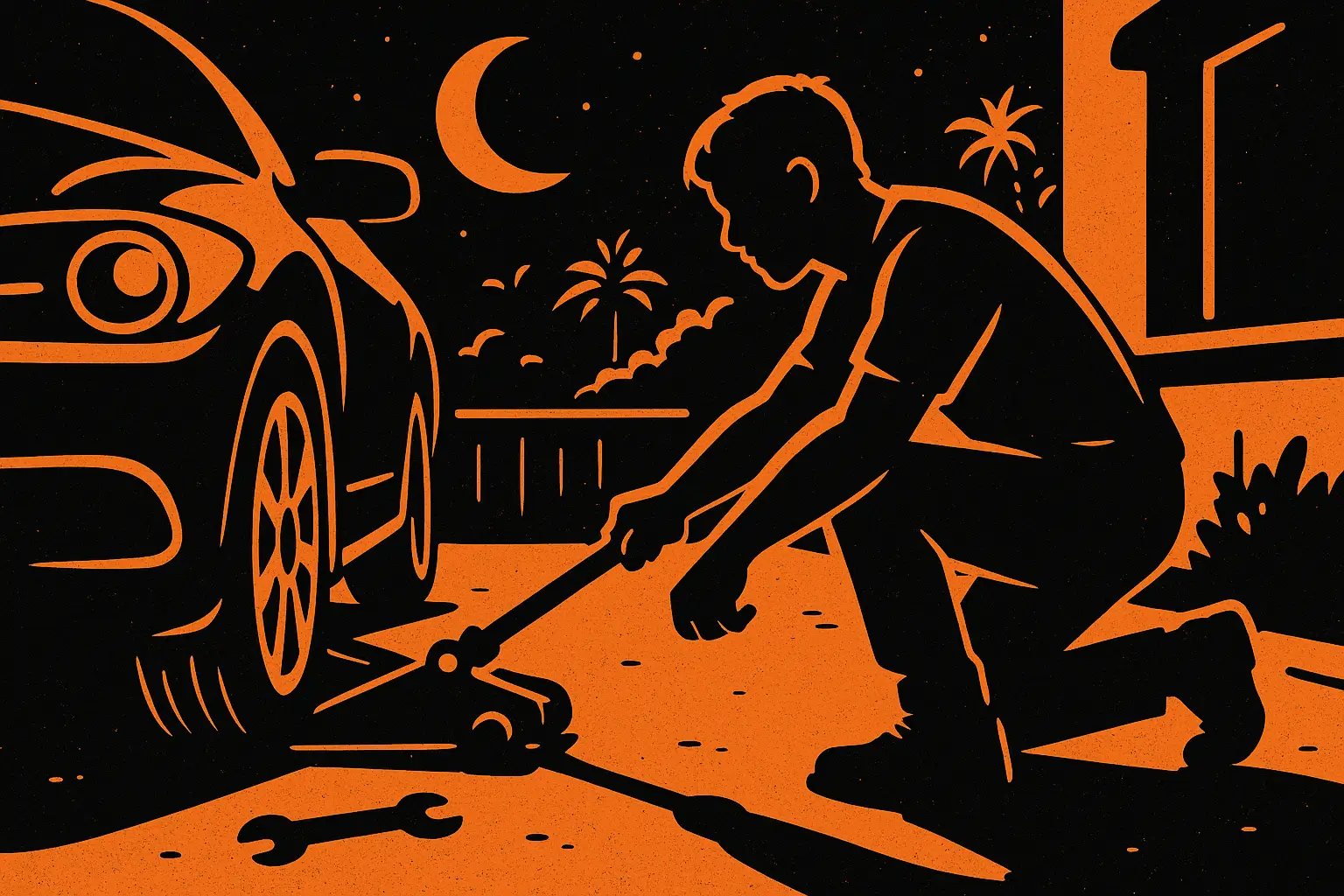
Your car needs attention. Maybe you’re rotating tires. Inspecting brakes. Checking for oil leaks.
Whatever the reason, you need to lift it off the ground. And if you do it wrong, the consequences aren’t just inconvenient. They’re dangerous.
Cars falling off jacks injure thousands of people yearly. Some fatalities. All preventable.
This guide walks you through the safe way to jack up your vehicle at home in Cyprus, whether you’re working in a Nicosia garage, a Limassol driveway, or a Paphos carport.
Before You Even Touch the Jack: Safety Foundations
Most accidents happen before the car leaves the ground. Prevention starts with preparation.
Choose the Right Location
Your working surface matters more than you think.
Ideal surfaces:
- Level concrete driveways
- Solid garage floors
- Paved areas with no slope
Avoid:
- Gravel or dirt (jack can sink or shift)
- Sloped driveways (car can roll)
- Hot asphalt in Cyprus summer (jack base can sink)
- Grass or soft ground
Cyprus heat softens asphalt significantly. If you must work on asphalt during summer, use a wide base plate under your jack to distribute weight. Early morning or evening works better when surfaces are cooler.
Engage the Parking Brake
Always. Every single time.
Set the parking brake firmly before you start. This isn’t optional, even on level ground.
Use Wheel Chocks
Place wheel chocks behind and in front of the wheels that will stay on the ground.
Don’t have proper chocks? Large pieces of wood work in a pinch. Bricks can crumble. Don’t risk it.
If you’re lifting the front, chock the rear wheels. Lifting the rear? Chock the front.
Never Work Under a Car Supported Only by a Jack
This is non-negotiable. Jacks are for lifting. Jack stands are for supporting.
Hydraulic jacks can fail. Seals leak. Valves stick. Mechanisms fail. If you’re under a car when it drops, you won’t get a second chance.
Always use jack stands rated for your vehicle’s weight once the car is lifted.
The Equipment You Actually Need
Proper tools make the difference between safe and sorry.
Floor Jack vs Scissor Jack
Scissor jacks come with your car. They’re designed for emergency tire changes only. Limited lift height, slower operation, less stable.
Floor jacks (hydraulic) are what you need for regular maintenance. Faster, more stable, higher lift capacity, easier to position.
For home garage work in Cyprus, invest in a quality floor jack. Your back and your safety will thank you.
Jack Stands Are Mandatory
A 2-ton jack stand pair costs less than a single emergency room visit. Do the math.
Buy stands rated above your vehicle’s weight. If your car weighs 1,500kg, use 2-ton (2,000kg) or 3-ton stands minimum.
Never substitute: Cinder blocks, stacks of wood, or other improvised supports crack and fail. Proper jack stands have safety locks. Use them.
Optional But Helpful Tools
- Torque wrench if removing wheels
- Gloves to protect hands
- Flashlight for finding jack points
- Rubber pad for jack to protect car’s underside
Ready to equip your home garage properly? Browse quality jacks and jack stands designed for safe vehicle maintenance to find the right equipment for your car and working conditions.
Finding Your Car’s Jack Points: The Critical Step
Every car has specific reinforced areas designed to bear lifting force. Use the wrong spot, and you’ll crush body panels or damage the frame.
Consult Your Owner’s Manual
Page one of safe jacking. Your manual shows exactly where to position the jack.
Lost your manual? Search “[your car make and model] jack points” online. You’ll find diagrams.
Common Jack Point Locations
Most vehicles have jack points:
- Behind the front wheels on the rocker panel
- In front of the rear wheels on the rocker panel
- Central points on the front and rear subframes
Look for:
- Reinforced metal sections
- Notches or grooves in the rocker panel
- Small welded brackets or tabs
Never jack from:
- Suspension components (can bend)
- Exhaust pipes (will crush)
- Oil pan (catastrophic damage)
- Body panels (will crumple)
Cyprus-Specific Consideration: Undercarriage Corrosion
Coastal Cyprus cars face salt air exposure. Larnaca, Limassol, and Paphos vehicles especially.
Check jack points for rust or corrosion before lifting. Weakened metal can fail under load. If corroded, consult a professional.
Step-by-Step: Safely Jacking Up Your Car
Now for the actual process. Follow this sequence exactly.
Step 1: Prepare the Vehicle
- Park on level ground
- Engine off, key removed
- Parking brake engaged
- Transmission in Park (automatic) or First gear (manual)
- Wheel chocks in place
- Locate jack points
Take your time here. Rushing creates mistakes.
Step 2: Position the Jack
Place the jack directly under the jack point. The jack’s lifting pad should center on the reinforced area.
Important: Don’t lift yet. Just position.
If using a floor jack, roll it into position. Make sure the wheels move freely and the handle operates smoothly.
Step 3: Initial Lift
Begin lifting slowly. Watch the jack pad as it contacts the car.
Stop immediately if:
- The jack slides or shifts
- The pad doesn’t center on the jack point
- You hear cracking or metal bending
Lower the jack, reposition, try again. Getting this right matters more than speed.
Step 4: Lift to Desired Height
Once positioned correctly, lift the vehicle to your working height.
General heights:
- Tire changes: Just enough to remove the wheel
- Brake work: 15-20cm clearance
- Undercarriage inspection: 30-40cm clearance
Never lift higher than necessary. Lower is safer.
Step 5: Immediately Place Jack Stands
This is where most people get lazy. Don’t.
As soon as the car reaches height, position jack stands under secure points near the jack. Common locations:
- Frame rails
- Subframe mounting points
- Reinforced rocker panel sections (different from jack points)
Adjust stand height to just below the support point. Slowly lower the car onto the stands using the jack. The vehicle’s weight should transfer to the stands, not the jack.
Step 6: Test Stability
Before getting under the car, test it.
Give the car a gentle shake. Does it rock? Not stable enough.
The vehicle should sit solidly on the jack stands with minimal movement.
Double-check:
- Stands are locked at proper height
- Base plates sit flat on ground
- Vehicle weight is on stands, not jack
- Stands aren’t tilted or leaning
Step 7: Keep the Jack in Place
Even with stands supporting the vehicle, leave the hydraulic jack in position as backup.
Lower it slightly so it’s not bearing weight, but keep it under the car. If a stand fails, the jack might prevent full collapse.
Think of it as insurance.
Working Under the Vehicle Safely
You’re lifted and supported. Now work smart.
Never Fully Slide Under
Keep as much of your body outside the vehicle’s footprint as possible. Work from the side whenever you can.
If you must go underneath, have someone nearby who knows you’re there.
Watch for Hot Components
Cyprus heat means your car’s undercarriage gets scorching hot. Exhaust systems, catalytic converters, and oil pans retain heat for 30+ minutes after driving.
Let everything cool before touching. Summer temperatures make burns more likely.
Keep Tools Organized
Scattered tools become tripping hazards. Stay organized.
Use a magnetic tray for bolts and small parts. You don’t want to search for a dropped nut while partially under a car.
Time Limits
Working under a jacked car is stressful physically and mentally. Take breaks every 20-30 minutes.
Stretch. Walk around. Check stand stability again. Stay sharp.
Common Mistakes That Cause Accidents
Learn from others’ errors.
Mistake #1: Using Only the Jack
People think, “I’ll be quick.” Then they get pinned.
Jack stands take 60 seconds to position. Use them every time.
Mistake #2: Jacking on Soft Ground
“It’ll be fine” ends badly. Jacks sink. Cars shift. People get hurt.
Move the car to solid ground. It’s worth the extra minute.
Mistake #3: Not Chocking Wheels
Even with the parking brake, cars can roll. Especially on slight inclines you don’t notice.
Chocks are cheap and essential. Use them.
Mistake #4: Lifting Too High
More height doesn’t mean better access. It means more instability and greater fall distance.
Lift only as high as needed.
Mistake #5: Ignoring Jack Capacity
Your jack says 2-ton capacity. Your SUV weighs 2.2 tons.
Math doesn’t lie. Use appropriately rated equipment.
Mistake #6: Skipping Maintenance on Equipment
Hydraulic jacks need occasional oil checks. Jack stands accumulate rust.
Inspect equipment before each use. If it’s damaged, replace it.
Lowering the Vehicle: The Right Way
Job done. Time to lower. Do this carefully too.
Step 1: Remove Tools and Parts
Clear everything from under the car. Double-check. Triple-check.
People have lowered cars onto toolboxes, creepers, and drain pans. Don’t be that person.
Step 2: Position the Jack
Slide the jack back under the original jack point. Lift slightly until the jack takes the vehicle’s weight off the stands.
Step 3: Remove Jack Stands
Only when the jack is supporting the weight. Remove stands one at a time and move them safely aside.
Step 4: Lower Slowly
Use controlled movements. Watch the car descend.
If something seems off, stop. Figure out what’s wrong before continuing.
Step 5: Final Check
Once the car is on the ground:
- Remove chocks
- Rock the car to settle suspension
- Check your work (wheels tight, nothing loose)
- Test brakes before driving (if you worked on brakes)
When to Call a Professional Instead
Some jobs aren’t worth the risk at home.
Skip DIY jacking if:
- You’re lifting an entire side or full vehicle (requires multiple stands and expertise)
- Your equipment is inadequate or damaged
- You’re working on heavily corroded vehicles
- The job requires extended time under the car
- You’re uncomfortable or unsure
Professional shops in Cyprus have lifts, proper insurance, and experience. Sometimes the €30-€50 labor charge is the smart choice.
Building Your Home Garage Setup
For regular DIY maintenance, invest properly from the start.
Essential equipment:
- Quality 2-3 ton hydraulic floor jack (€60-€150)
- Pair of jack stands rated for your vehicle (€40-€100)
- Set of wheel chocks (€15-€30)
- Work gloves and safety glasses (€10-€20)
Nice-to-have additions:
- Creeper for easier undercar access
- Magnetic parts tray
- Jack pad adapters for low-clearance cars
- Rubber jack pads to protect undercarriage
Find professional-grade equipment built for safety at our complete selection of jacks and jack stands for home automotive work. Invest in quality once, use it for years.
The Bottom Line on Safe Jacking
Most car maintenance isn’t complicated. But it requires respect for the risks involved.
A 1,500kg vehicle falling even 30cm generates enormous force. No human body withstands that impact.
The rules aren’t complicated:
- Solid, level ground
- Proper jack points
- Appropriate equipment
- Jack stands every time
- Slow, deliberate movements
Follow these principles, and jacking your car at home is perfectly safe. Skip them, and you’re gambling with serious injury.
Cyprus’s DIY car culture is strong. Plenty of people successfully maintain their vehicles at home. They do it safely because they take it seriously.
Your turn. Invest in proper equipment. Learn your car’s jack points. Work methodically.
The independence of home car maintenance is rewarding. The risk of doing it wrong is catastrophic.
Choose wisely. Work safely. Drive confidently.