You’re building your home gym. The essentials are covered: weights, bench, maybe a rack.
Now you’re eyeing massage guns. Everyone at the gym uses them. Instagram fitness influencers swear by them. But you’re staring at price tags ranging from €100 to €600.
Do you actually need one? Or is this just another fitness gadget that’ll collect dust next to your ab roller?
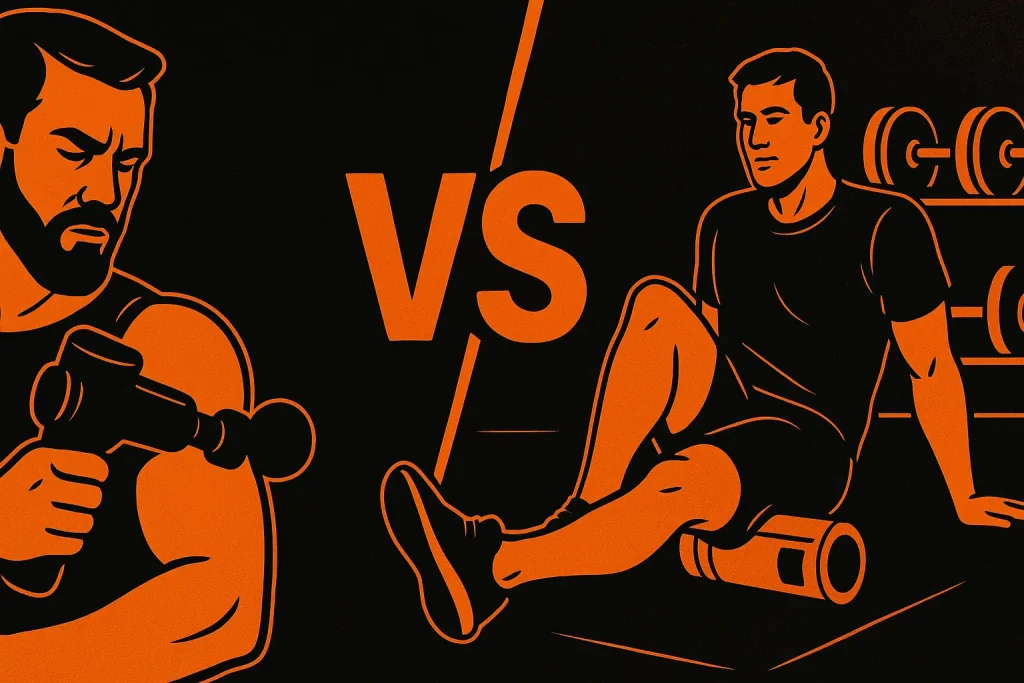
Let’s cut through the marketing hype and figure out if a massage gun deserves a spot in your recovery arsenal.
Traditional Recovery Methods: What You’re Already Doing
Before massage guns existed, athletes recovered just fine. They still do. Let’s acknowledge what works.
Foam Rolling
The foam roller has been the recovery MVP for decades. It’s cheap, durable, and effective.
Pros:
- Costs €15-€40 for a quality roller
- Never needs charging or maintenance
- Targets large muscle groups well
- Portable and lightweight
Cons:
- Requires you to move your body weight around
- Hard to reach certain areas (upper back, glutes)
- Painful on sore muscles
- Limited pressure control
- Time-consuming to position correctly
Static Stretching
Old school. Free. Available anywhere.
Pros:
- Zero cost
- Improves flexibility over time
- Reduces muscle tension
- Can be done anywhere
Cons:
- Takes 15-20 minutes to do properly
- Easy to skip when you’re tired
- Passive, not addressing deep tissue knots
- Requires knowledge of proper technique
Sports Massage
Professional massage therapy delivers incredible results. No question.
Pros:
- Targets specific problem areas expertly
- Full-body relaxation
- Professional assessment of issues
- Addresses muscle imbalances
Cons:
- €50-€100 per session
- Requires appointments
- Not practical 3-4 times weekly
- Not available when you need immediate relief
Ice and Heat Therapy
Time-tested, simple, effective for certain conditions.
Pros:
- Inexpensive
- Good for acute injuries
- Reduces inflammation
Cons:
- Messy and inconvenient
- Doesn’t address muscle knots directly
- Takes 15-20 minutes of sitting still
- Limited to surface-level treatment
What Massage Guns Bring to the Table
Now let’s talk about what makes these devices different.
Percussive Therapy on Demand
Massage guns deliver rapid pulses that penetrate deep into muscle tissue. We’re talking 30-50 pulses per second depending on the model.
This isn’t surface-level. It reaches layers that foam rolling can’t touch and stretching doesn’t address.
The key difference? You control the intensity, duration, and exact placement in real-time.
Pinpoint Accuracy
Got a specific knot in your trap? A tight spot in your calf?
Foam rollers hit general areas. Massage guns target the exact 2-inch section giving you problems. This precision matters when you’re dealing with specific trigger points or adhesions.
Speed and Convenience
Here’s where massage guns shine brightest. Recovery time.
A foam rolling session: 15-20 minutes of rolling around on the floor.
A massage gun session: 5-10 minutes hitting every major muscle group while standing or sitting normally.
When you’re tired after training, convenience determines whether you actually recover or skip it entirely.
Accessibility
Try foam rolling your upper back effectively. Go ahead. It’s awkward at best, impossible at worst.
Massage guns reach almost everywhere. Upper traps, rear delts, even parts of your back with the right attachment. You maintain control without contorting your body into weird positions.
The Head-to-Head Comparison
Let’s get specific about how massage guns stack up.
Effectiveness for Muscle Recovery
Traditional methods: Proven effective. Foam rolling and stretching both have decades of research supporting their benefits.
Massage guns: Newer research, but studies show comparable or superior results for reducing DOMS (delayed onset muscle soreness) and improving range of motion. The percussive action appears to clear metabolic waste faster than passive stretching.
Winner: Massage guns, slightly. The combination of deep tissue penetration and convenience gives them an edge.
Cost Over Time
Traditional methods:
- Foam roller: €30 one-time purchase
- Professional massage: €50-€100 per session
Massage guns: €150-€400 one-time purchase (quality models)
The math: If you get professional massages even once monthly, a massage gun pays for itself in 3-4 months. Compared to foam rolling alone, the payback period is longer, but the enhanced effectiveness justifies the cost.
Winner: Massage guns for regular users. Traditional methods for occasional recovery needs.
Convenience Factor
Traditional methods: Foam rolling requires floor space and physical effort. Stretching takes time and discipline. Massage appointments require scheduling.
Massage guns: Grab it, turn it on, done in minutes. Use it while watching TV or between sets at your home gym.
Winner: Massage guns dominate here. Not even close.
Learning Curve
Traditional methods: Foam rolling technique takes practice. Knowing which stretches target which muscles requires education.
Massage guns: Point and shoot, essentially. Yes, there are best practices, but the barrier to entry is minimal.
Winner: Massage guns for simplicity.
Injury Risk
Traditional methods: Low risk when done correctly. Foam rolling can cause bruising if too aggressive. Stretching can strain muscles if forced.
Massage guns: Low risk when used properly on muscles. Higher risk if misused on bones, joints, or injuries.
Winner: Tie. Both are safe with proper technique, problematic without it.
When You Actually NEED a Massage Gun
Let’s get practical. A massage gun makes sense if:
You Train 4+ Times Weekly
Serious training demands serious recovery. If you’re in the gym frequently, the cumulative muscle stress requires consistent treatment.
Professional athletes use massage guns daily. Why? Because recovery happens between sessions, not during them. If you’re training at that volume, you need professional-level recovery tools.
You Have Chronic Muscle Tightness
Desk job plus gym sessions? That’s a recipe for perpetually tight hip flexors, traps, and chest muscles.
Traditional stretching helps. But stubborn knots require more aggressive treatment. Massage guns address chronic tightness more effectively than passive stretching alone.
You Work Remotely or Have Limited Mobility
Can’t easily get to the floor for foam rolling? Mobility issues make traditional methods challenging?
Massage guns work from a chair or standing position. Accessibility is a game-changer for people with physical limitations.
You’re Avoiding Expensive Massage Therapy
If you’re currently paying for weekly or bi-weekly massages, do the math. A quality massage gun costs less than 4-6 professional sessions.
You won’t replicate everything a skilled therapist does. But for maintenance between sessions or replacing routine appointments entirely, massage guns deliver excellent ROI.
Your Home Gym Is Your Primary Training Space
Building a complete home gym means investing in recovery equipment, not just training tools.
If you’ve spent money on a squat rack, barbell, and plates, spending €200-€300 on a massage gun is proportional to your investment in training infrastructure.
When You DON’T Need a Massage Gun
Be honest. You might not need one if:
You Train Casually (1-2 Times Weekly)
Light training doesn’t create the muscle stress that demands aggressive recovery tools. Basic stretching and occasional foam rolling handle your needs.
Save your money for other priorities.
You Already Get Regular Professional Massage
If you’re seeing a massage therapist weekly and you’re satisfied with your recovery, adding a massage gun is redundant.
Maybe consider it for between-session maintenance, but it’s not essential.
You’re on a Tight Budget
€150-€400 is real money. If your budget is stretched, priorities matter.
A foam roller for €30 delivers 70% of the benefits at 10% of the cost. Start there. Upgrade later when finances allow.
You Hate Noisy Devices
Even quiet massage guns make noise. If you live in close quarters or the sound bothers you, this matters.
Traditional recovery methods are silent. That’s worth something.
Making the Investment Decision
Here’s the framework for deciding:
Calculate your massage therapy spending: If you spend more than €300 annually on professional massage, a massage gun makes financial sense.
Assess your training volume: 4+ training sessions weekly? Your body needs the support. 2 or fewer? Probably not essential.
Consider your recovery consistency: Do you currently skip recovery because it’s inconvenient? A massage gun removes that barrier. If you’re disciplined with foam rolling and stretching, maybe you’re fine.
Think about your home gym completeness: Are you building a comprehensive setup or just starting? Massage guns fit into complete home gyms, not minimal setups.
The Hybrid Approach: Best of Both Worlds
You don’t have to choose exclusively. Many serious athletes combine methods:
- Massage gun for targeted pre-workout muscle activation and post-workout recovery
- Foam roller for general tissue work and mobility
- Stretching for flexibility and cool-down
- Professional massage monthly or quarterly for deep work
This comprehensive approach addresses recovery from multiple angles. Each tool has strengths. Use them accordingly.
Finding the Right Massage Gun If You Decide to Buy
If you’ve decided a massage gun fits your needs, focus on:
Amplitude: 12-16mm for most users Battery life: 2+ hours minimum Noise level: Under 60 decibels for home use Attachments: At least 4 heads for different muscle groups Warranty: 1+ year coverage
Ready to explore your options? Browse professional-grade massage guns for every budget and compare features to find the best fit for your home gym.
The Honest Answer
Do you need a massage gun? Probably not. People recovered from training for decades without them.
Do you benefit from a massage gun if you train seriously? Absolutely.
The question isn’t whether they work. They do. The question is whether the convenience, effectiveness, and time savings justify the investment for your specific situation.
If you’re building a home gym, training regularly, and serious about recovery, a massage gun is one of the smartest purchases you’ll make. It’s not sexy like a new barbell or exciting like bumper plates, but it directly impacts your ability to train consistently without pain.
And consistency? That’s what actually builds results.
Make your decision based on your training volume, budget, and recovery needs. Not on what someone else is doing. Your recovery strategy should be as personalized as your training program.
Compare features, read reviews, and choose wisely at our complete selection of quality massage guns designed for serious athletes. Your muscles will thank you.