You’ve seen them everywhere. Instagram ads. Your gym buddy’s bag. Maybe even your physical therapist’s office.
Massage guns have exploded in popularity over the past few years, becoming a must-have recovery tool for athletes, weekend warriors, and office workers alike. But here’s what everyone wants to know: do these handheld devices actually deliver on their promises, or are they just another fitness fad destined to collect dust in your closet?
As a fitness professional who’s worked with hundreds of clients, I’ve witnessed the massage gun revolution firsthand. Let me break down exactly what the science says, what these tools can (and can’t) do for your body, and whether they’re worth your hard-earned money.
What Exactly Are Massage Guns?
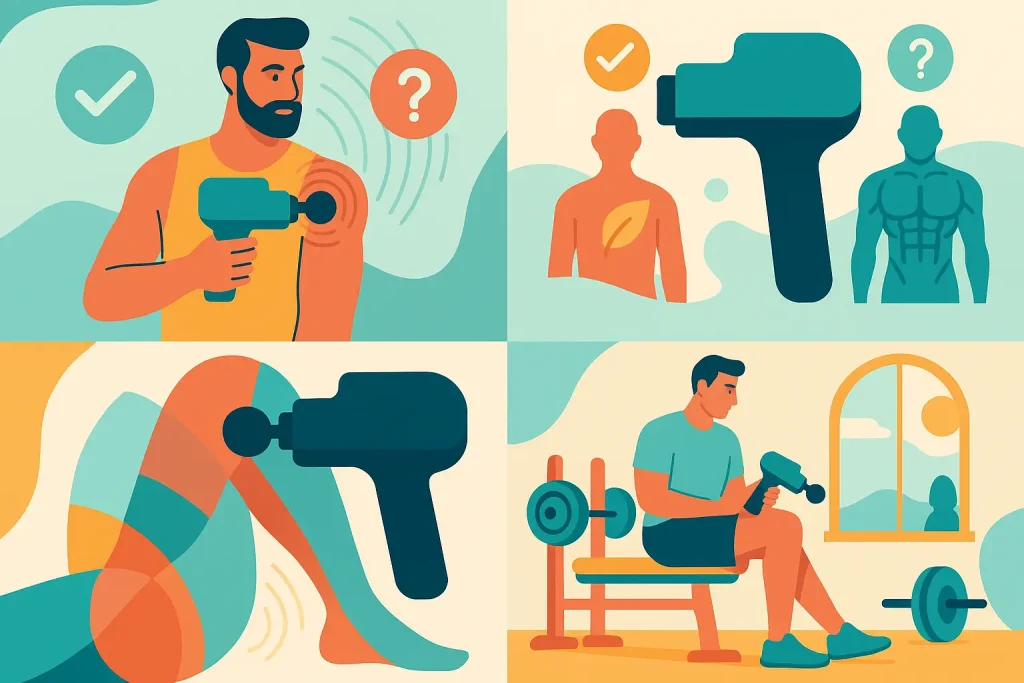
Massage guns, also called percussion therapy devices, are handheld tools that deliver rapid bursts of pressure into your muscle tissue. Think of them as mini jackhammers for your muscles, but in a good way.
Most devices operate at speeds ranging from 1,200 to 3,200 percussions per minute. They come with various attachment heads designed for different muscle groups and purposes. Some attachments are soft and cushioned for sensitive areas. Others are firm and pointed for targeting specific trigger points.
The concept isn’t new. Physical therapists and sports medicine professionals have used percussion therapy for decades. What’s changed? The technology is now affordable, portable, and available to everyone.
The Science Behind Percussion Therapy
Does the research support all the hype? Actually, yes.
Percussion therapy works by stimulating your muscles in several ways. When the device rapidly pulses against your skin, it activates mechanoreceptors in your muscle tissue. These are sensory neurons that respond to mechanical pressure.
This stimulation triggers multiple beneficial responses:
- Increased blood flow to the treated area
- Activation of the parasympathetic nervous system (your body’s “rest and digest” mode)
- Reduced muscle tension and knot formation
- Decreased perception of pain through the gate control theory
- Enhanced range of motion in joints and muscles
The gate control theory is particularly interesting. Essentially, your nervous system can only process so many sensations at once. The rapid percussion creates a competing stimulus that can override pain signals traveling to your brain. It’s like turning down the volume on your muscle soreness.
Studies have shown that percussive therapy can reduce delayed onset muscle soreness (DOMS) by up to 30%. That post-workout stiffness you feel 24 to 48 hours after training? Massage guns can genuinely help minimize it.
What Massage Guns Actually Do For Your Body
Let’s get specific. Here’s what these devices can accomplish:
Accelerate Recovery Between Workouts
After intense training, your muscles accumulate metabolic waste products like lactic acid. They also develop micro-tears that need time to repair. Percussion therapy increases circulation, which helps flush out waste products and deliver oxygen-rich blood to damaged tissue.
Does this mean you’ll recover instantly? No. But you might shave off a day of soreness and get back to training sooner.
Reduce Muscle Tension and Stiffness
Sit at a desk all day? Your neck, shoulders, and back probably feel like concrete by 5 PM.
Massage guns excel at releasing muscle tension. The rapid percussions help relax contracted muscle fibers and break up adhesions (those pesky knots). Many of my clients report immediate relief from chronic tightness, especially in the upper trapezius, lower back, and IT band.
Improve Range of Motion
Tight muscles restrict your movement. That’s a problem whether you’re trying to squat deeper, reach overhead, or simply tie your shoes without grunting.
Using a massage gun before activity can temporarily increase your flexibility. Research suggests that just 30 seconds of percussion therapy can improve range of motion as effectively as static stretching. The advantage? You don’t have to hold uncomfortable positions for minutes at a time.
Activate Muscles Pre-Workout
This one surprises people. Massage guns aren’t just for recovery.
Using your device before exercise can “wake up” dormant muscles and improve their activation patterns. Spend 30 to 60 seconds on your glutes before squats, for example. You’ll likely feel a better mind-muscle connection during your set.
What Massage Guns Can’t Do
Time for some real talk. These devices have limitations.
They won’t fix structural problems. If you have a herniated disc, torn ligament, or severe postural imbalance, a massage gun isn’t going to solve it. You need professional medical care.
They’re not magic fat burners either. Some marketing claims suggest percussion therapy can break down fat cells or reduce cellulite. There’s no credible scientific evidence supporting this. Save your money on “fat-blasting” promises.
Massage guns also can’t replace proper training, nutrition, and sleep. Recovery is multifaceted. Your device is one tool in a larger toolkit, not a miracle cure that compensates for poor lifestyle habits.
And please, don’t use them on injuries. Acute sprains, strains, fractures, or inflamed areas should never be treated with percussion therapy. You risk making the injury worse.
Who Benefits Most From Massage Guns?
Not everyone needs a $600 percussion device. But certain groups see exceptional results:
Athletes and Regular Gym-Goers
If you train three or more times per week, you’re producing enough muscle fatigue to benefit from enhanced recovery tools. Competitive athletes often use massage guns daily, sometimes multiple times per day.
People With Chronic Muscle Tension
Office workers, drivers, and anyone who maintains static positions for hours. Your chronically tight muscles respond beautifully to regular percussion therapy. Ten minutes a day can feel life-changing.
Physical Therapy Patients
Many physical therapists incorporate massage guns into treatment plans. They’re particularly effective for breaking up scar tissue, improving tissue quality, and managing chronic pain conditions.
Active Agers
Older adults maintaining fitness routines often deal with persistent stiffness and longer recovery times. Massage guns can help keep muscles supple and reduce the achiness that comes with aging.
How to Use a Massage Gun Effectively
Owning the device is one thing. Using it correctly is another.
Start gently. Begin on the lowest speed setting and gradually increase intensity. Your muscles shouldn’t feel brutalized. If you’re wincing or tensing up, you’re going too hard.
Move slowly over the muscle. Spend about 30 seconds to 2 minutes per muscle group. Don’t stay in one spot for more than 10 to 15 seconds unless you’re working a specific trigger point.
Follow the muscle fibers. Work along the length of the muscle, not against it. For your quadriceps, move vertically from hip to knee. For your pectorals, work from your sternum outward toward your shoulder.
Avoid these areas completely:
- Directly on bones or joints
- The front or side of your neck
- Your abdomen or lower back near the kidneys
- Anywhere you have cuts, bruises, or inflammation
Timing matters too. Use your massage gun for 5 to 10 minutes before workouts to prime your muscles. After training, wait until your heart rate returns to normal, then use it for 10 to 15 minutes to enhance recovery.
Massage Guns vs. Other Recovery Methods
How do these devices stack up against alternatives?
Traditional massage therapy provides deeper work and targets fascia layers that massage guns can’t reach. A skilled therapist also identifies compensation patterns and structural issues. However, massage therapy is expensive and requires scheduling appointments.
Foam rolling is cheaper and works similarly to massage guns. But it requires more effort. You’re using your body weight and moving yourself over the roller. Massage guns let you relax while the device does the work.
Stretching improves flexibility through different mechanisms. It’s free and essential for long-term mobility. Combine it with percussion therapy for best results.
The ideal recovery protocol? Use all of these methods strategically rather than relying on just one.
Are They Worth the Investment?
Quality massage guns range from $100 to $600. Is that justified?
If you’re serious about fitness and recovery, absolutely. The device pays for itself quickly compared to regular massage therapy sessions. A single professional massage costs $60 to $120. Ten sessions equal the price of a high-quality massage gun that lasts years.
But don’t buy the most expensive model just because it has more bells and whistles. Mid-range options ($200 to $300) typically offer everything most people need: multiple speed settings, decent battery life, and various attachments.
Look for these features:
- At least three speed settings
- Battery life of 2+ hours
- Amplitude (stroke length) of at least 12mm
- Reasonable noise level (under 65 decibels)
- Ergonomic grip design
Cheaper models under $100 often lack power, have short battery life, and break within months. They’re frustrating investments that don’t deliver therapeutic benefits.
The Bottom Line on Massage Guns
So, do massage guns really work? Yes, they do.
The science supports their effectiveness for reducing muscle soreness, improving range of motion, accelerating recovery, and managing chronic tension. They’re not miracle devices, but they’re legitimate tools backed by research and clinical use.
Will everyone experience dramatic results? No. Your mileage varies depending on how consistently you use the device, the quality of your unit, and your individual physiology. Some people notice immediate, profound relief. Others experience subtle improvements that accumulate over time.
What matters most is having realistic expectations. Massage guns are powerful recovery aids that complement proper training, nutrition, sleep, and stress management. They’re not replacements for these foundational elements.
If you’re an active person dealing with persistent muscle tightness, training regularly, or recovering from workouts more slowly than you’d like, a quality massage gun is probably worth adding to your routine. The investment pays dividends in how you feel day to day and how you perform in your activities.
Just remember: consistency beats intensity. Five minutes daily produces better results than occasional aggressive sessions that leave you bruised.
Your muscles will thank you.
Ready to find the right massage gun for your recovery needs? Browse our curated selection of professional-grade massage guns to compare features, prices, and find the perfect device for your fitness routine.