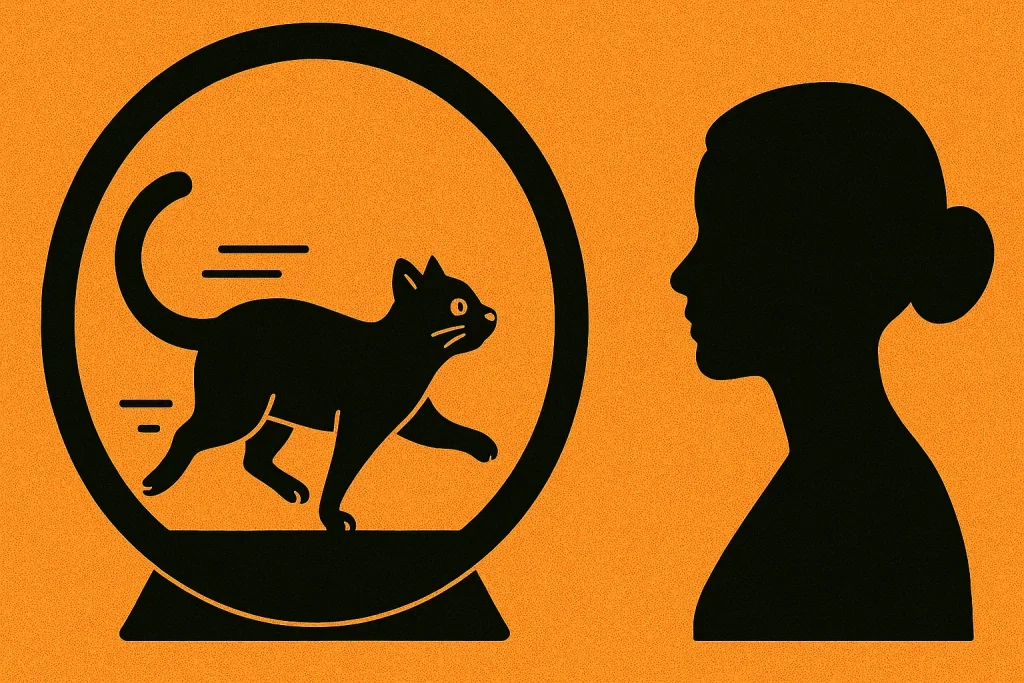
It’s 3:17 AM. Again.
Your cat is sprinting across your bed, launching off your face, and ricocheting off the walls like a furry pinball. The zoomies have arrived. And they’ve chosen violence.
You’re exhausted. You have work in the morning. But your cat? Your cat has decided that right now is the perfect time for a full-blown Olympic sprint event through your bedroom.
Sound familiar?
You’re not alone. And no, your cat isn’t broken. This nighttime chaos has a solution that doesn’t involve sleeping with your door locked or rehoming your beloved feline.
Why Cats Go Crazy at Night (It’s Not Personal)
Your cat isn’t trying to ruin your sleep. They’re following ancient programming.
Cats are crepuscular hunters. That means they’re naturally wired to be most active at dawn and dusk. In the wild, this is prime hunting time when prey is most vulnerable.
Your domestic cat doesn’t need to hunt. But those instincts? Still firing on all cylinders.
The real problem: Modern indoor cats don’t get enough physical activity during the day. They sleep 16-20 hours. Then when their internal clock says “hunt,” all that pent-up energy explodes at once.
At 3 AM. On your face.
The Energy Equation
Think about it mathematically. Your cat has:
- Natural hunting drive
- Zero physical outlets during your workday
- Tons of stored energy
- No understanding that humans need sleep
The result? Nighttime zoomies that leave you wondering if you adopted a cat or a caffeinated squirrel.
Why Traditional Solutions Fail
You’ve probably tried the usual advice.
Playing before bed: Great in theory. But 10 minutes with a feather toy doesn’t burn enough energy for a young, active cat. It’s like doing one pushup and expecting to be exhausted.
Ignoring the behavior: Sure, reinforcement theory sounds smart. But try ignoring a cat parkour-ing off your dresser at 2 AM. Your willpower has limits. So does your sleep schedule.
Closing the bedroom door: Now you just have a screaming, scratching concert outside your door instead of zoomies inside it. Progress?
More toys: Toys require human participation or quickly become boring. Your cat isn’t entertained by the same mouse toy for the 47th consecutive day.
These solutions fail because they don’t address the root cause: your cat needs to burn serious energy, and you can’t be awake all night facilitating it.
Enter the Cat Wheel: The Game-Changer
Cat wheels look like giant hamster wheels, and yes, they seem ridiculous at first glance.
But here’s what makes them brilliant for nighttime zoomies.
They’re Always Available
Your cat can use a wheel at 3 PM or 3 AM. No human required.
That burst of energy that would normally land on your face? Your cat can sprint it out on the wheel instead. Problem solved.
They Provide Real Exercise
We’re not talking about light play. A cat running on a wheel gets genuine cardiovascular exercise.
Five minutes of wheel running burns more energy than 20 minutes of sporadic toy chasing. The continuous motion engages their prey drive while exhausting their muscles.
Active breeds like Bengals, Abyssinians, and Savannahs especially benefit. These cats need athlete-level exercise that traditional play can’t provide.
They Redirect Hunting Instincts
Running triggers the same neurological pathways as chasing prey. Your cat gets the satisfaction of the “hunt” without shredding your curtains or attacking your feet under the covers.
It’s enrichment that actually enriches, not just distracts temporarily.
How to Actually Get Your Cat Using a Wheel
Buying a cat wheel doesn’t magically solve zoomies. You need a strategy.
Phase 1: Introduction (Days 1-3)
Place the wheel in a high-traffic area where your cat already spends time. Don’t hide it in a corner. Make it part of their environment.
Don’t force it. Let your cat investigate naturally. Some cats hop on immediately. Others need time.
Sprinkle treats inside the wheel. Put their favorite toys near it. Create positive associations without pressure.
Phase 2: Encouragement (Days 4-10)
Use interactive toys to get your cat moving near the wheel. Feather wands work perfectly.
Wave the toy past the wheel opening. Let your cat chase it. When they step onto the wheel surface, praise them.
The key moment: When your cat takes their first steps and the wheel moves, stay calm. Over-excitement can startle them. Act like it’s the most normal thing in the world.
Phase 3: Building Confidence (Days 11-21)
Once your cat understands the wheel moves, encourage longer sessions.
Use a toy to lead them in gentle runs. Start slow. Build to faster speeds gradually.
Some cats figure out running independently within days. Others need weeks of guided practice. Patience wins here.
Phase 4: Independence (Week 4+)
Most cats eventually use the wheel on their own, especially once they associate it with fun and energy release.
You’ll know you’ve succeeded when you wake up at 3 AM to the gentle whoosh of the wheel instead of paws on your face. That’s victory.
Choosing the Right Cat Wheel
Not all wheels are created equal. Consider these factors:
Size matters. The wheel should be large enough that your cat runs with a natural gait, not a cramped curve. Most cats need wheels 48 inches in diameter or larger.
Stability is crucial. A wobbly wheel scares cats and won’t support vigorous running. Look for sturdy construction with a wide base.
Noise level. Some wheels squeak or rumble. For nighttime use, this defeats the purpose. Read reviews carefully about sound.
Space requirements. These wheels are big. Measure your space before buying. They typically need 4-5 feet of clearance.
Ready to explore your options? Browse cat wheels designed for active felines and compare sizes, features, and customer reviews to find the perfect fit for your energetic cat.
Real Talk: Does This Actually Work?
For many cat owners, yes. Dramatically.
Will every cat become an enthusiastic wheel runner? No. Some cats have zero interest, and that’s okay. Personality matters.
But for high-energy cats, especially young adults and active breeds, cat wheels often transform nighttime behavior within weeks.
The typical progression:
- Week 1: Novelty, investigation, maybe a few tentative steps
- Week 2-3: Short play sessions, increasing confidence
- Week 4+: Regular use, especially during their natural active periods
- Month 2+: Established routine, significantly reduced nighttime disruptions
Maximizing Success: Additional Tips
The wheel works best as part of a complete strategy.
Scheduled play sessions: Even with a wheel, engage your cat with interactive toys twice daily. Morning and evening work well.
Feeding schedule: Feed your cat’s main meal before your bedtime. A full stomach triggers sleepiness, mimicking the post-hunt rest cycle.
Environmental enrichment: Add vertical spaces, window perches, and puzzle feeders. A stimulated cat is a tired cat.
Consistent routine: Cats thrive on predictability. Same play times, same feeding times, same bedtime routine.
The wheel becomes the centerpiece of an energy management system, not the only tool.
When to Expect Results
Be realistic. Behavioral change takes time.
Some cats adapt immediately and start running within days. Others need 4-6 weeks of gradual acclimation.
Signs it’s working:
- Reduced nighttime disruptions
- Your cat using the wheel independently
- More relaxed behavior overall
- Longer, deeper sleep periods (both yours and theirs)
If your cat shows zero interest after two months of gentle encouragement, they might be in the minority that won’t use wheels. That’s when you explore other high-energy outlets like vertical cat furniture or supervised outdoor time.
The Investment Question
Cat wheels aren’t cheap. Quality models run €150-€400.
Is it worth it?
Calculate the value:
- Better sleep quality for you
- Healthier, happier cat
- Reduced destructive behavior
- Years of use (these things last)
Compare that to ongoing costs of replacing destroyed furniture, broken sleep affecting work performance, or stress-related vet bills from an under-stimulated cat.
For households with high-energy cats, the wheel pays for itself in sanity alone.
Your Path to Peaceful Nights
Night-time zoomies aren’t a character flaw. They’re a sign your cat needs more physical activity than traditional play provides.
A cat wheel offers a solution that works with your cat’s natural instincts instead of fighting them. It gives them an outlet for that 3 AM energy surge that doesn’t involve your face.
Will it work for every cat? No. But for active, energetic felines, especially young cats and hyperactive breeds, it’s often the difference between chaos and calm.
Your cat wants to run. They need to run. Give them a place to do it, and everyone sleeps better.
Stop suffering through another sleepless night. Explore quality cat wheels built for active cats and take the first step toward quieter, more restful nights for both you and your feline athlete.
Your 3 AM self will thank you.